
BBI Contributing Editor
While many patient monitoring companies focus on the market for their products in U.S. hospitals, which is a mature, mostly saturated market, they overlook the market for their devices in freestanding ambulatory surgical centers (ASCs) to some extent. This may be because their sales organizations are not structured to call on these accounts, or that there is not as complete information about such accounts available from most sources as there is for hospitals. According to surveying done by Medical Strategic Planning (Lincroft, New Jersey), there are about 2,200 ASCs operating in the U.S.
|
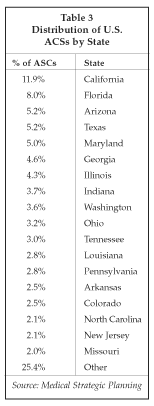
In Table 3, all unlisted states comprise the Other category, and all of these account for less than 2% each of the total. Alabama, Kansas, Wisconsin, Michigan, Nevada, New York, Oklahoma, Oregon, South Carolina and Virginia each account for more than 1% of the total, and other states account for less than 1% of the total. Not surprisingly, states like California, Florida, Arizona, Texas and Georgia are popular retirement locations, and much of the ambulatory surgery is performed on this patient population.The total number of operating suites in these ASCs is slightly over 5,100, and there are approximately 2,200 recovery rooms in these facilities. This is a significantly different relationship than for inpatient or hospital-based perioperative departments. Unlike their hospital-based counterparts, there are fewer gas machines in ASCs, due primarily to the greater number of ambulatory procedures performed under local or regional anesthesia. However, the percentage of ASC operating rooms that have gas machines has been increasing over the last five years, as the complexity and length of procedures performed in the outpatient setting has been increasing. Currently, 76% of ASC operating rooms have gas machines available, according to Medical Strategic Planning's 2002 ASC survey data.The ASC market continues to grow and expand, so it contains both a growth piece and a replacement piece (since some of these surgicenters are old enough to be replacing the equipment they purchased when they bought when these centers were established in the 1990s). Some are on their second round of replacements. While the rate of growth of such centers is slowing a bit, it still represents one of the few unsaturated markets left in patient monitoring.
This hasn't escaped the notice of several of the second-tier monitoring vendors who have focused on this segment and quietly grabbed market shares that are larger here than they have mustered in the inpatient hospital perioperative space. The unquestioned leader in the freestanding ASC space is Datascope (Montvale, New Jersey) with an impressive 46% market share, while this same competitor has only a 9% share in the hospital perioperative sector. By way of contrast, Philips Medical Systems (Andover, Massachusetts), which controls 41% of the hospital perioperative space, has only a 7.5% cumulative share of the domestic ASC space.
A company known for its operating room gas machines, Datex-Ohmeda (Madison, Wisconsin), which ranked fourth behind Philips, Spacelabs (Redmond, Washington), GE Medical Systems (Waukesha, Wisconsin) and Datascope in the hospital perioperative monitoring space, now jumps to second, with almost a 29% market share, when combined with Spacelabs, which it just acquired. But this is vulnerable turf, as the majority is Spacelabs' market share, not Datex-Ohmeda's, and they will have to hold on to that share from an onslaught of competitive vendors who are targeting the current Spacelabs units in operating rooms and other clinical areas. Datex-Ohmeda ranks second, even without Spacelabs, in the ambulatory surgical center market with a 14% market share — almost 40% higher than it achieves in the hospital perioperative space (again, without Spacelabs). Unfortunately, Spacelabs is less help to Datex-Ohmeda in the ASC space, as it has obtained an unimpressive seventh-place position with a market share of only 4.5%.
Philips, in spite of a 7.5% market share in ASC, ranks third, far behind Datascope, and is tightly bunched with a group of competitors including Criticare (Milwaukee, Wisconsin), GE Medical, Spacelabs and Welch Allyn Monitoring (Beaverton, Oregon), all of which have 4% or greater market shares. The spread between the market leader's share, and the bunching of major competitors in the 4% to 7% market share range, indicates that these companies are ignoring this small segment. If they continue to do so, there is room for several of the smaller companies to enter and succeed in this market segment. Some non-traditional companies are doing just that. Defibrillator companies such as Medtronic PhysioControl (Seattle, Washington), Zoll Medical (Burlington, Massachusetts) and Cardiac Science (Irvine, California) have discovered their ability to provide both a monitor and a defibrillator as a single integrated product at an aggressive price compared to the more traditional patient monitoring market leaders. Price is certainly an important factor in this market segment. Monitor+defibrillator combinations now account for more than 15% of the total monitors placed in ASCs and are rapidly growing now that automatic external defib+monitor combinations have become relatively inexpensive. Indeed, much of the growth in Philips' penetration of the ambulatory surgical center segment has been via the back door, thanks to its monitor/defib product combinations.
Due to the less-frequent use of general anesthesia, the monitoring requirements for the ASC space is somewhat less complex than for the hospital perioperative space. Many monitors that lack anesthetic agent ID capabilities are installed and used in ASCs, which often provide anesthesia via multiple drugs administered by IV rather than by gas machine. This has allowed vendors such as Welch Allyn Monitoring (formerly Protocol), and others who are not players in the hospital perioperative space to gain at least some market share in the less-acute freestanding ASC space.
We see a number of new competitors entering both markets. Siemens Medical (Danvers, Massachusetts), which has a less than 2% share in the hospital perioperative segment, is moving aggressively to expand its share there. So are Fukuda Denshi and Nihon Kohden in some markets, and Invivo Research (Orlando, Florida), with its new Millennia monitor and improved anesthetic agent ID device, can be expected to become more competitive. Movers in this segment include Datex-Ohmeda, GE Medical, Criticare Systems and Datascope, all of which have been expanding their market shares over the last two years. As the battle for position in mature, saturated markets continues in the U.S., tiny segments such as ASC are among the few remaining jewels.
The mystery remains why successful perioperative vendors in the hospital space have been so slow to also attack the freestanding ambulatory surgical center space. While this segment is and will remain relatively small, it is nonetheless attractive, particularly to smaller competitors who can price their products aggressively and offer more cost-effective, lower-acuity solutions.