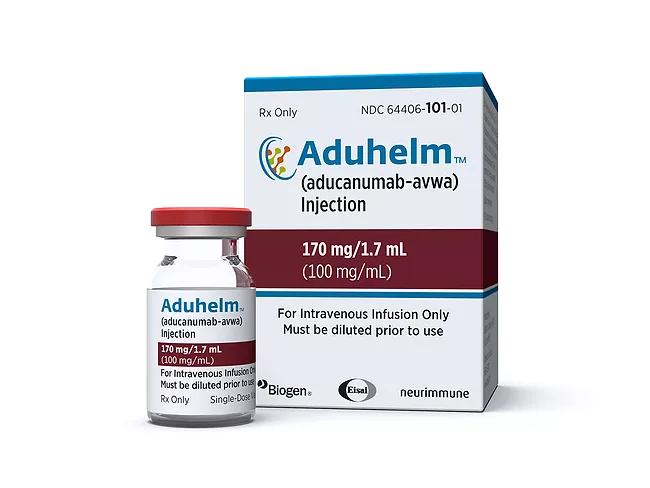
European regulators have put off a decision on Biogen Inc and Eisai, Co. Ltd.’s controversial Alzheimer’s drug, aducanumab, for likely another month, after the companies announced further supportive data from a follow-up under review by the FDA.
As part of its pharmacovigilance program for Alzheimer’s drug Aduhelm (aducanumab), Biogen Inc. is evaluating a handful of reports published in the FDA Adverse Event Reporting System Public Dashboard, including the Aug. 18 death of a 75-year-old woman with Alzheimer’s and other co-morbidities.
For the first time this year, BioWorld’s Biopharmaceutical Index is showing signs of life with an increase of 5.6%, boosted primarily by Alzheimer’s disease efforts from Biogen Inc. and Eli Lilly and Co. Biogen’s stock (NASDAQ:BIIB) is up about 36.4% this year and has been front and center due to its controversial FDA approval for Aduhelm (aducanumab) in June. Lilly’s stock (NYSE:LLY) has climbed by more than 44%, and it was granted breakthrough therapy designation a month ago for its Alzheimer’s candidate donanemab.
A sometimes contentious policy roundtable on how to handle Alzheimer’s disease therapies followed the July 15 meeting of the California Technology Assessment Forum, an independent evidence appraisal committee of the Institute for Clinical and Economic Review (ICER). CTAF’s 15 panelists voted unanimously that the evidence was not adequate to prove Biogen Inc.’s recently approved Aduhelm (aducanumab) superior to supportive care alone.
Members of the California Technology Assessment Forum (CTAF), an independent appraisal committee of the Institute for Clinical and Economic Review (ICER), discussed – and voted on – the safety vs. efficacy and other aspects of Biogen Inc.’s embattled Aduhelm (aducanumab), the amyloid beta-targeting therapy recently approved for Alzheimer’s disease. It didn’t go well for Biogen.
As rumblings continued about possible skulduggery between Biogen Inc. and the FDA related to Aduhelm (aducanumab), an already precedent-setting case took yet another turn: Acting FDA Commissioner Janet Woodcock asked acting U.S. Inspector General Christi Grimm’s office to conduct an independent review of goings-on that led to approval of the amyloid-beta-targeting drug in Alzheimer’s disease.
Following battles over its price and accelerated approval, Biogen Inc. and Eisai Co. Ltd.’s Aduhelm (aducanumab) now has newly approved prescribing information from the FDA that limits the patient population and sales along with it. The updated Indications and usage now reads that the anti-amyloid beta monoclonal antibody should be used only in patients with mild cognitive impairment due to Alzheimer’s disease or mild Alzheimer’s dementia. That’s the patient population in which treatment was initiated in clinical trials that led to approval. The company said the new wording “clarifies the indication.” The original FDA-approved language cleared the drug for much broader use in Alzheimer’s.
The FDA’s recent release of documents related to its accelerated approval of Aduhelm (aducanumab) did little to reduce the controversy surrounding that decision and the U.S. pricing of Biogen Inc.’s Alzheimer’s drug.
New FDA breakthrough therapy designations awarded for two investigational Alzheimer's disease (AD) candidates, Eli Lilly and Co.'s donanemab and the Bioarctic AB-Eisai Co. Ltd.-developed asset lecanemab (BAN-2401) underline ongoing willingness at the U.S. regulator to invest deeper attention in the potential of amyloid plaque reduction to slow progress of the disease, a critical and costly challenge estimated to affect more than 6 million Americans.
More than two weeks after the FDA gave its go-ahead to Biogen Inc.’s Aduhelm (aducanumab), controversy still rages over the accelerated approval as well as the price for the anti-amyloid beta monoclonal antibody for Alzheimer’s disease (AD). Embattled U.S. regulators made the uncommon move of releasing documents – with more due to be made public later – that show the internal deliberations that led to Aduhelm’s clearance.