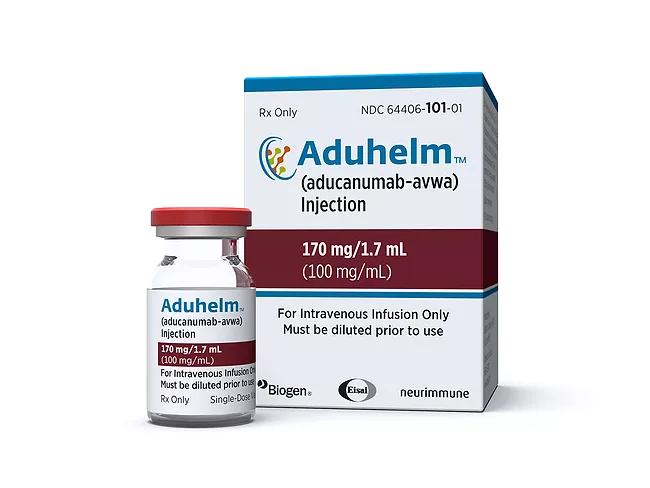
While comments continue to pour in, both in opposition and support, regarding the U.S. Centers for Medicare & Medicaid Services’ (CMS) proposed national coverage decision that would restrict Medicare coverage of monoclonal antibodies intended to treat Alzheimer’s to those used in CMS- or NIH-approved clinical trials, some groups also are appealing to Health and Human Services (HHS) Secretary Xavier Becerra to step into an HHS agency turf war.
The U.S. Center for Medicare & Medicaid Services (CMS) opened a 30-day comment window on its proposed national coverage determination (NCD) to limit Medicare access to monoclonal antibodies targeting amyloid beta in Alzheimer’s disease (AD) only in clinical trials. Biogen Inc., clearly the target, along with its AD treatment Aduhelm (aducanumab), was among the first to respond.
In proposing a national coverage determination to limit coverage of a class of Alzheimer’s drugs to those being used in clinical trials approved by the U.S. Center for Medicare & Medicaid Services or the NIH, CMS appears to be treading in FDA territory. “For the first time ever, Medicare is second-guessing FDA – and not only on work that it has already done, but on work FDA will do in the future,” said George Vradenburg, chair and co-founder of Us Against Alzheimer’s, a patient advocacy group. “HHS [the Department of Health and Human Services] is clearly at war with itself, with one agency approving this class of drugs and another slamming the door shut on treatment. . .. Does CMS no longer trust the FDA’s work?”
“There isn’t a better place to be” now than in Alzheimer’s disease (AD) drug development, said Phyllis Ferrell, global head of external engagement in AD and neurodegeneration at Eli Lilly and Co., during Biotech Showcase’s panel talk titled, “Aduhelm: Stimulating the Next Generation of AD Treatment.”
This could be a make-or-break week for Biogen Inc., with the U.S. Centers for Medicare & Medicaid Services (CMS) expected to announce a draft coverage decision for the company’s Alzheimer’s drug, Aduhelm.
Astrazeneca plc’s recently acquired Alexion Pharmaceuticals Inc. has signed a deal worth up to $760 million with Neurimmune AG, the Swiss biotech that discovered Alzheimer’s drug Aduhelm (aducanumab), buying rights to amyloidosis drug NI-006. While Biogen Inc.’s Aduhelm targets amyloid plaques thought to cause Alzheimer’s in the brain, the phase Ib drug in Alexion’s deal is intended to tackle the build-up of the rogue protein that causes heart disease caused by transthyretin amyloid cardiomyopathy (ATTR-CM).
DUBLIN – The EMA has rejected Biogen Inc.’s application for European Union approval of Aduhelm (aducanumab), its controversial Alzheimer’s disease drug. Its human medicines committee (CHMP) issued a negative opinion on Biogen’s dossier during its December meeting this week, stating that the data from the key studies submitted in support of the application “were conflicting and did not show overall that Aduhelm was effective at treating adults with early stage Alzheimer’s disease.”
In 2021, no drug approval garnered as much attention and debate as Biogen Inc.’s Aduhelm (aducanumab). The FDA’s surprise, accelerated approval of Aduhelm for Alzheimer’s disease flew in the face of the recommendation by an advisory committee, causing a stir that included the resignation of three adcom members, along with publicly made claims that the company’s relationship with regulators had become too cozy.
A European approval for Alzheimer’s drug aducanumab by year-end looks even more in doubt. A week after being called in before the EMA’s Committee for Medicinal Products for Human Use (CHMP) for an oral explanation of the trial data, Biogen Inc. said it received a “negative trend vote” on the marketing authorization application. A formal opinion by the CHMP is expected at its December meeting, but analysts are not optimistic.
Technically speaking, the scientific community as a whole cannot say for sure whether and how well Aduhelm (aducanumab, Biogen Inc./Eisai, Co., Ltd.) works. After all, two years after the initial report of the Engage and Emerge data at the 2019 Clinical Trials in Alzheimer’s Disease (CTAD), the full trial data have still not been published in a peer-reviewed publication. Which, of course, is one of the problems with Aduhelm.