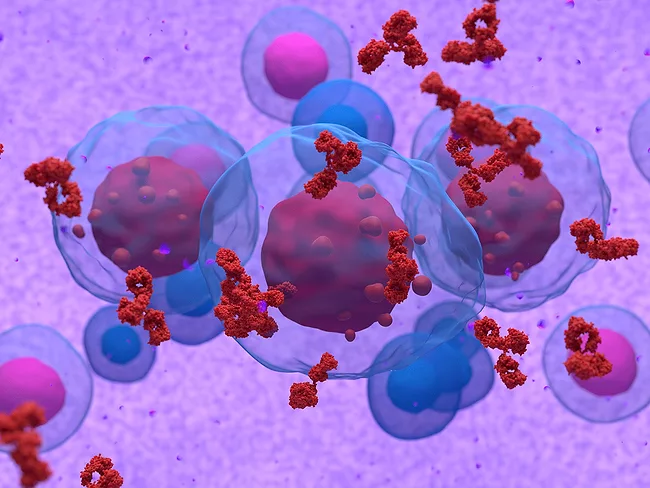
The rough ride presaged by briefing documents came to pass for GSK plc with the drug first approved by the U.S. FDA as Blenrep (belantamab mafodotin, bel-maf), as the agency’s Oncologic Drugs Advisory Committee (ODAC) appraised the possibility that the antibody-drug conjugate could return to market for relapsed/refractory multiple myeloma (r/r MM).
As the July 23 PDUFA date nears for GSK plc’s Blenrep (belantamab mafodotin), the U.S. FDA’s Oncologic Drugs Advisory Committee will decide July 17 on whether available data justify the return to market of the antibody-drug conjugate as a therapy for relapsed/refractory multiple myeloma, and briefing documents made public ahead of the meeting laid out the issues.
Nearly six years after Ichnos Sciences Inc. launched operations, a subsidiary of the now-named Ichnos Glenmark Innovation (IGI) Inc. has signed with Abbvie Inc. a global licensing partnership for trispecific antibody ISB-2001 worth $1.925 billion plus royalties. ISB-2001, which targets BCMA, CD38 and CD3, is in a phase I trial for relapsed/refractory multiple myeloma and has orphan drug and fast track status in the U.S
Brightpath Biotherapeutics Co. Ltd.’s iPS cell-derived BCMA CAR-natural killer T cell therapy candidate has been awarded orphan drug designation by the FDA for the treatment of multiple myeloma.
It may be a year later than originally planned, but Regeneron Pharmaceuticals Inc. is set to commercialize Lynozyfic (linvoseltamab) in the U.S. following FDA approval for use in adults with relapsed and refractory multiple myeloma. A bispecific antibody targeting B-cell maturation antigen (BCMA) and CD3, Lynozyfic was cleared under the accelerated approval pathway, with continued approval contingent upon a confirmatory trial.
Multiple myeloma bone disease (MBD) lacks effective biomarkers; recent evidence involves exosomal circRNAs in the progression of cancer, but their roles in the field have not been deeply explored. The aim of this study was to explore the role of component of oligomeric golgi complex 5 (COG5) and shed light on its osteolytic mechanism.
Cullinan Therapeutics Inc. swept up ex-China rights to a multiple myeloma (MM)-targeting BCMAxCD3 bispecific T-cell engager (TCE) velinotamig from Chongqing Genrix Biopharmaceutical Co. Ltd. via a potential $712 million deal June 4. The plan is to repurpose the cancer drug to autoimmune disease.
Cullinan Therapeutics Inc. swept up ex-China rights to a multiple myeloma (MM)-targeting BCMAxCD3 bispecific T-cell engager (TCE) velinotamig from Chongqing Genrix Biopharmaceutical Co. Ltd. via a potential $712 million deal June 4. The plan is to repurpose the cancer drug to autoimmune disease.
Multiple myeloma (MM) is a complex and heterogeneous blood cancer, and current risk assessment tools like the Revised International Staging System (R-ISS) have limitations in accurately predicting prognosis, especially for the intermediate-risk R-ISS II group.
In their efforts to develop next-generation drugs whose structures differ from those of conventional IMiDs, researchers at Fujimoto Pharmaceutical Corp. developed FPFT-2216 through optimization of a lead compound.