Springboarding off the success of its AI-based imaging software for cancer detection, the deep learning-based artificial intelligence (AI) company Lunit Inc. has another AI software, called the Lunit Scope, up its sleeve for which it hopes to gain U.S. FDA approval by 2025.
Springboarding off the success of its AI-based imaging software for cancer detection, the deep learning-based artificial intelligence (AI) company Lunit Inc. has another AI software, called the Lunit Scope, up its sleeve for which it hopes to gain U.S. FDA approval by 2025.
The U.S. FDA’s final guidance for premarket submissions for device software functions serves as a much needed overwrite of a badly outdated policy but includes some significant changes over the legacy guidance. There are also a few changes between the 2021 draft and the 2023 final guidance, however, such as a call for more details about how software anomalies were discovered and what a root cause analysis would suggest about the origin of the anomaly.
Premature babies face challenges in the neonatal intensive care unit (NICU) as their heart, lungs and neurological system continue to develop outside the womb. Roughly half of neonates born at 26 weeks to 28 weeks gestation experience respiratory distress. These infants often need extra oxygen and help breathing, as well as constant monitoring to ensure oxygen is absorbed and carbon dioxide (CO2) is dispelled. To that end, Etiometry Inc. received FDA clearance for its IVCO2 Index, a software tool for use in monitoring risk of hypercapnia in NICU patients weighing less than 2 kg.
Startup Brightheart SAS raised €2 million (US$2.14 million) in seed financing, from Sofinnova Partners, that will allow the company to accelerate the development of its artificial intelligence software, which helps physicians detect congenital heart defects in fetuses. Brightheart hopes that the technology will improve the detection of complex congenital heart defects during prenatal ultrasound screening as intervening early could address fetal malformations or abnormalities and improve a baby’s chance of survival.
The U.S. FDA has granted 510(k) clearance to GE Healthcare Technologies Inc. for its Precision DL for PET/CT, an artificial intelligence (AI) and deep learning (DL)-powered software designed to sharpen quality and improve efficiencies in medical imaging. Part of the company’s Effortless Recon DL portfolio, the technology is available on GE’s Omni Legend PET/CT digital scanner.
Developers of clinical decision support (CDS) software have their hands full with a recent U.S. FDA final guidance on these products, but the picture promises to become more byzantine with the publication of a draft rule by the Office of the National Coordinator (ONC). The new ONC proposal would require a demonstration of transparency for decision support intervention (DSI) predictive functions in order for that software to qualify for ONC certification, a requirement that might not overlap neatly with the FDA’s own transparency requirements.
Illumina Inc. released Connected Insights in a beta version for the U.S., following its commercial release in other selected countries. Connected Insights, an assay-agnostic, cloud-based software designed to streamline interpretation and reporting across next-generation sequencing (NGS) types, was initially developed for somatic oncology applications, the system will shortly also support whole genome sequencing for rare diseases.
Huma Therapeutics Ltd. received the first EU Class IIb approval for a software as a medical device (SaMD) product, winning the certification for its system for collecting and analysing patient data across multiple disease indications, the company reported. The approval will open up the market for digital health apps, with customers now able to link into Huma’s underlying technical platform to develop their own digital health apps and companion diagnostics, avoiding the need to then get their own, separate EU medical device certification.
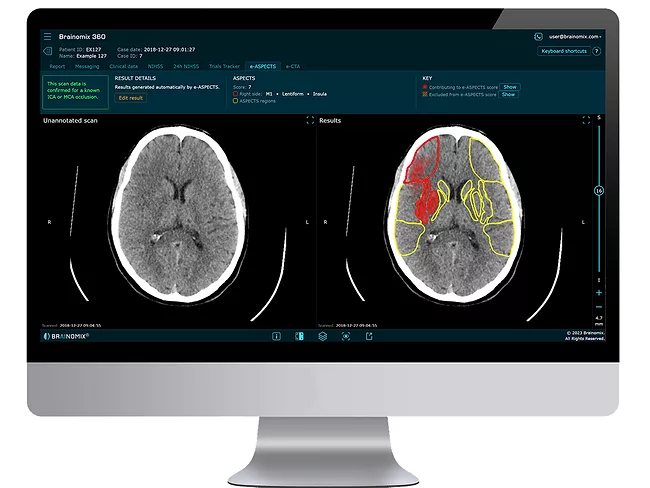
Brainomix Ltd. received U.S. FDA clearance for its Brainomix 360 E-aspects tool, a fully automated AI-imaging solution for stroke assessment. Powered by explainable AI, the Brainomix 360 E-aspects tool, which is already CE-marked, assesses non-contrast CT scans to automatically generate a score and measures the volume of ischemic signs. It also features an overlaid heatmap to visually assist clinicians when treating stroke patients.