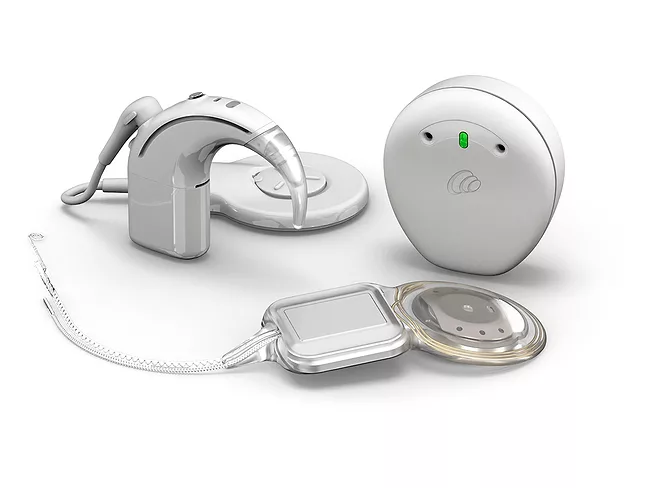
Shares in Aussie hearing implant maker Cochlear Ltd. plummeted nearly 39% April 22 after the company slashed fiscal 2026 earnings guidance and warned that weaker-than-expected demand in developed markets was exposing a more cyclical and discretionary side to its business than investors had assumed.
Shares in Aussie hearing implant maker Cochlear Ltd. plummeted nearly 39% April 22 after the company slashed fiscal 2026 earnings guidance and warned that weaker-than-expected demand in developed markets was exposing a more cyclical and discretionary side to its business than investors had assumed.
Boston Scientific Corp.'s CEO Mike Mahoney said that the year is turning out to be “more challenging” than the company anticipated, prompting a cut to its organic sales growth guidance to 6.5% to 8%, from 10% to 11%. The company also lowered its adjusted earnings-per-share guidance to $3.34 to $3.41, from $3.43 to $3.49 previously. Analysts welcomed the lower guidance seeing it as somewhat of a relief and an opportunity to reset on the back of the company’s share price, which has fallen sharply over the last year.
Medtronic plc this week reported that the first commercial surgical cases using its Hugo robotic-assisted surgery system have been completed in the U.S. Hugo is expected to be a key growth driver for the company, especially with opportunities in the underpenetrated U.S. soft tissue surgical robotics market. The company also posted third-quarter fiscal year 2026 organic revenues of $9.02 billion, up 6% year‑on‑year.
Despite reporting strong fourth-quarter (Q4) organic sales growth of $5.29 billion, up 12.7% year-on-year, Boston Scientific Corp. saw its shares plunge more than 17% in early trading. Investors appeared disappointed by weaker U.S. sales in the electrophysiology and Watchman businesses, two of the company’s growth engines, and concern over the 2026 organic growth guidance provided by management of 10% to 11%, down from the 15.8% seen in 2025.
Abbott Laboratories reported fourth quarter sales below expectations before the market opened on Jan. 22, sending the stock down nearly 12% from the prior day's closing. The biggest hits came from contraction in the nutrition group along with continued disruption in the diagnostics unit from volume-based procurement in China. Medical devices suffered from market share loss in electrophysiology and slower than expected uptake of continuous glucose monitors. The pharma group performed as anticipated, posting 7% growth.
With the number of beats Boston Science Corp. has posted in recent years, it could be auditioning as a heavy metal drummer. Third quarter results kept up the streak, with overall sales 2% ahead of consensus at $5.07 billion and earnings per share of 75 cents, 5% above the Street’s expectations. The company’s two market-transforming products, Watchman and Farapulse, led the strong across-the-board performance, which would be no surprise by now except when looking at the stunning growth rates and sales both posted in the same quarter last year.
Johnson & Johnson beat analysts’ expectations for its second quarter results, led by medical device sales of $8.54 billion. All med-tech segments performed better than anticipated, with cardiology reporting exceptionally strong 22.3% growth. In addition, the innovative medicines division shocked the Street with 4.9% growth, despite the loss of patent protection for the blockbuster drug, Stelara.
Abbott Laboratories’ second quarter results echoed Johnson & Johnson’s, with med tech performing the hero’s work with strong growth. Overall, Abbott slightly beat expectations with sales up 6.9% overall compared to 2Q 2024, largely boosted by the med-tech unit’s organic revenue increase of 12.2%, and worldwide sales for the quarter of $11.1 billion. Diabetes provided a particularly bright spot with 19.5% year-over-year growth for continuous glucose monitoring devices.
Johnson & Johnson beat analysts’ expectations for its second quarter results, led by medical device sales of $8.54 billion. All med-tech segments performed better than anticipated, with cardiology reporting exceptionally strong 22.3% growth. In addition, the innovative medicines division shocked the Street with 4.9% growth, despite the loss of patent protection for the blockbuster drug, Stelara.