The individual and population-level health impact of type 2 diabetes is well documented, a fact which recently drove the U.S. Preventive Services Task Force (USPSTF) to ask whether screening among asymptomatic individuals aged younger than 18 years would be worth the effort. The answer is that the task force simply does not know, simply because the agency’s literature search turned up no studies that prospectively evaluated the benefits of screening in this population, signaling a missed opportunity for drug and device makers to intervene in this massively costly disease.
The U.S. Government Accountability Office (GAO) recently published a report on the pandemic-driven expansion of telehealth for Medicare beneficiaries, and pointed to some privacy and security risks of which patients may be unaware. However, GAO also noted that the CMS does not yet have a good handle on the rate of telehealth fraud and has not yet collected reliable data on telehealth outcomes, two gaps that will have to be filled if Congress is to comfortably vote to make permanent some of these pandemic-driven telehealth policies.
The saga of U.S. FDA regulation of clinical decision support (CDS) software has spanned six years since the passage of the 21st Century Cures Act, yielding two FDA draft guidances and a final guidance that emerged only Sept. 27, 2022. Regulatory attorney Brad Thompson blasted the final guidance for its addition of “time-critical decision making” to the definition of a regulated medical device, one of several features he argued are extra-statutory and which effectively handcuff both developers of CDS and the physicians who use their products to aid in selecting drug and device treatments.
The COVID-19 pandemic may or may not be over, depending on which member of the U.S. government’s executive branch one asks, but the FDA’s device center has drawn much tighter lines around its emergency use authorization (EUA) program for COVID-19 tests.
The U.S. FDA’s final report for the software pre-certification (pre-cert) pilot program for software as a medical device (SaMD) highlighted a number of both positive and negative developments, but the agency reiterated its call for new statutory authorities for review of SaMD. However, the agency also acknowledged that the pilot was itself compromised by the absence of that statutory authority because the absence of such authority means that the results of these mock product reviews cannot be legally walled off from non-pilot applications.
Legislation to reauthorize a number of U.S. FDA user fee programs has once again languished until the 11th hour, but the House and Senate committees of jurisdiction have apparently come to terms over the matter. However, the parties to this deal are characterizing it as a “clean” bill, which suggests that FDA regulation of lab-developed tests (LDTs) and a center of drug manufacturing of excellence will have to wait for another day or – because of the upcoming mid-term elections – most likely another year.
Clearpoint Neuro Inc. said Clinical Laserthermia Systems AB (CLS), snared a 510(k) from the FDA for a laser interstitial therapy system that will be marketed in the U.S. as part of the Clearpoint Prism Neuro system. This product package adds to a growing Clearpoint footprint in the neurological disorders space, adding to an inventory that already consists of targeted drug delivery and deep brain stimulation systems.
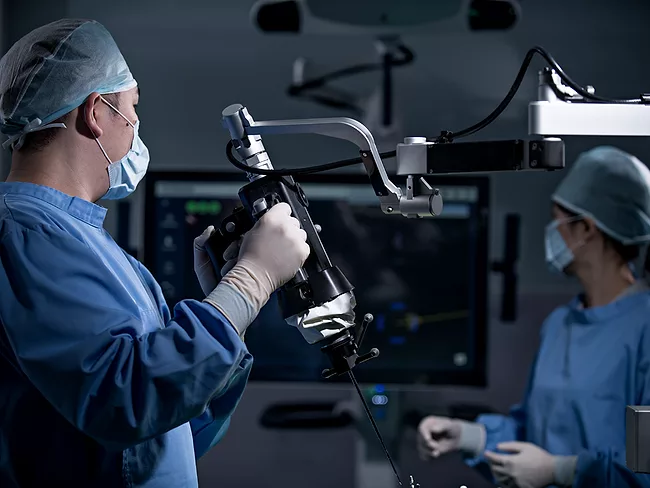
With FDA 510(k) clearance of its Kinguide robotic-assisted surgical system, Point Robotics Medtech Inc became the first robotics company in Taiwan to gain U.S. clearance for an orthopedic surgical robot.
Colorectal cancer (CRC) is expected to increase steadily through the decade to reach more than 2.2 million cases and 1.1 million deaths by 2030 as two concurrent trends tick up—an aging population, that typically has higher rates of the disease, and an alarming increase in cases in younger people. Iterative Scopes Inc. hopes to help gastroenterologists find precancerous lesions before they progress with its Skout device, which received U.S. FDA 510(k) clearance this week.