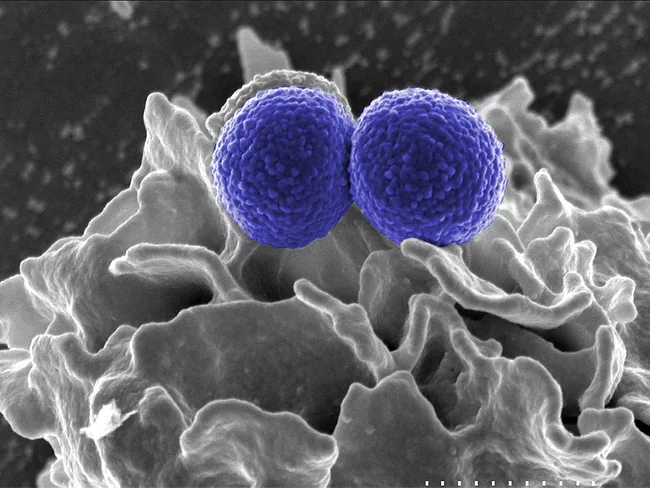
Researchers at Leiden University have synthesized semisynthetic guanidino lipoglycopeptides with in vitro and in vivo activity gram-positive bacteria, including methicillin-resistant and vancomycin-resistant Staphylococcusaureus.
Several cancer types are treated with epidermal growth factor receptor (EGFR)-targeting agents (EGFR inhibitors), but this treatment is associated with dermal toxicity in up to 90% of cases, where 80% of cases have rash, among other issues. This skin toxicity is mainly driven by elevation of Staphylococcus aureus and the proinflammatory cytokine IL-36γ. Skin keratinocytes’ cutaneous immune defense is impaired by EGFR inhibitors.
Evaxion Biotech A/S and a collaborator have successfully concluded a series of large nonrodent animal infection studies testing antigens from Evaxion’s preclinical EVX-B1 vaccine candidate against Staphylococcus aureus. The EVX-B1 antigens were shown to significantly reduce disease burden.
Merus NV added Gilead Sciences Inc. to its collaboration roster, entering a deal potentially worth more than $1.5 billion. While its previous agreements have focused primarily on bispecific antibodies, the Gilead alliance takes aim at trispecifics, antibodies capable of binding three targets at once. In other news, shares of Biomx Inc. (NYSE:PHGE) jumped 194% March 6, ending the day at 68 cents, up 45 cents, on news that it was merging with fellow phage-focused company Adaptive Phage Therapeutics Inc. and raised $50 million in a concurrent private placement.
Ohio State University has synthesized DNA topoisomerase II (bacterial) inhibitors reported to be useful for the treatment of Staphylococcus aureus infections.
Limmatech Biologics AG and Abvacc Inc. have entered into a license agreement that grants Limmatech the exclusive rights to further develop Abvacc’s multivalent toxoid vaccine candidate, LBT-SA7 (formerly IBT-V02), designed to prevent infections caused by Staphylococcus aureus.
The emergence of Staphylococcus aureus strains resistant to almost all approved antibiotics in the clinic poses an urgent public health concern. Thus, new antibiotics exploiting alternative antibacterial mechanisms or molecular structures are critically needed to address the long-term threat of multidrug-resistant S. aureus, particularly methicillin-resistant S. aureus (MRSA).
North Carolina State University has synthesized vancomycin derivatives containing a 2,3-pyrrolidinedione moiety and reported to be useful for the treatment of bacterial infections.
Evaxion Biotech A/S has presented promising results on EVX-B1, a vaccine against Staphylococcus aureus containing antigens identified using artificial intelligence. EVX-B1 induces strong immune responses, both cellular and humoral, that translate to a high level of protection in preclinical models for skin infection and sepsis.
A chance discovery has led to a new class of antibiotics with multiple arms that interacted with the cell wall of gram-positive bacteria, inhibiting their assembly and disarming them. “It was an accidental discovery. We were using it to stain cells. We also were running evaluations of antibiotics. One of my former students came to me and said: ‘I think we have discovered something that is quite potent as an antibiotic,’” the senior author Xingyu Jiang told BioWorld.