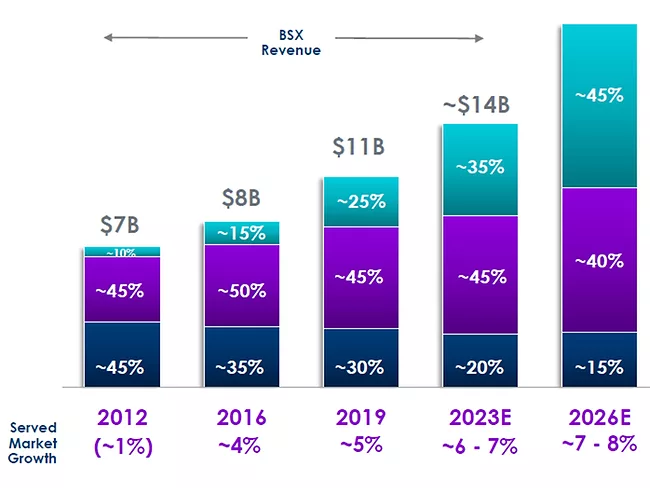
At its Investor Day on September 20, Boston Scientific Corp. unveiled an ambitious long-range plan to become “the highest performing med-tech large-cap company” in terms of financial performance, sales growth, EPS, execution and talent retention.” That’s a notable step up from its 2021 goal of being just one of the top performers.
The annual volume of implant of transcatheter aortic valve replacement (TAVR) devices has grown steadily over the years, and that volume might sustain its upward trajectory over the next few years if the results of a new analysis of more than 46,000 TAVR patients gain traction. The data for these patients with minimally symptomatic aortic stenosis (AS) predictably indicated that this group was less susceptible to bad outcomes than those with more severe symptoms, but one of the hopes is that earlier intervention into AS could ward off future cardiovascular events, a finding which might justify expanded payer coverage for TAVR in these patient populations.
Gradient Denervation Technologies SAS closed a €14 million (US$15 million) series A financing round that will help the company with the ongoing clinical development and evaluation of its ultrasound-based catheter device to treat pulmonary hypertension. The financing round was led by Asabys Partners, with participation from Thuja Capital and founding investor Sofinnova Partners.
The U.S. FDA recently posted another round of recalls for the Cardiosave line of intra-aortic balloon pumps (IABPs) by Datascope Corp., advising users to make sure they have a backup unit at the ready in the case of device failure. However, the agency noted that “alternative treatments are limited,” a clear sign that this market lacks competition, most likely due to a lack of incentives for the private sector to invest in this class of devices.
Four months after raising $55 million, Magenta Medical Ltd. reported the completion of enrollment to a U.S. FDA-approved early feasibility study with the Elevate percutaneous left ventricular assist device (pLVAD).
The markets for ventricular assist devices (VADs) and intraortic balloon pumps (IABPs) are hardly littered with competition, but the few companies that work in these two device categories have faced seemingly routine recalls over the past couple of years. The U.S. FDA recently reported yet another round of class I recalls for a single model in both Abiomed Inc.’s Impella line of VADs and Datascope Corp.’s Cardiosave line of IABPs, but the agency’s apparent unwillingness to force either manufacturer to withdraw any of these recalled products seems to suggest that product shortages would quickly follow any such move on the FDA’s part.
The FDA’s recent clearance of Ultrasight Inc.’s artificial intelligence (AI)-powered ultrasound guidance technology will allow for the widespread detection of heart diseases in the U.S. and ease bottlenecks in the healthcare system that currently restrict access for many people, Davidi Vortman, CEO of Ultrasight told BioWorld. Ultrasight’s software helps medical professionals without sonography experience acquire cardiac ultrasound images at the point of care in multiple settings.
Recalls are a fact of life in the medical technology space, and Medtronic plc and Quidel Cardiovascular Inc., have both been forced to report class I recalls. Dublin-based Medtronic announced a recall of more than 348,000 cardiac electrophysiology devices due to issues that could prevent high-voltage therapy while San Diego-based Quidel is recalling nearly 7,800 Triage cardiac panels because of a risk of false negatives for patients being assessed for an infarct.
Shineco Inc.’s subsidiary Changzhou Biowin Pharma received marketing approval from China’s NMPA for its test device that can complete a diagnosis of acute myocardial infarction in five minutes. The five-minute cardiac test relies on a combination of three major cardiac markers that can detect cardiac troponin I, myoglobin and heart fatty acid binding protein in a single test.
Lifetech Scientific Corp.’s fully degradable iron-based absorbable coronary scaffold showed its safety and efficacy to treat non-complex coronary lesions that have not been previously treated with an interventional device during a three-year, first-in-humans trial.