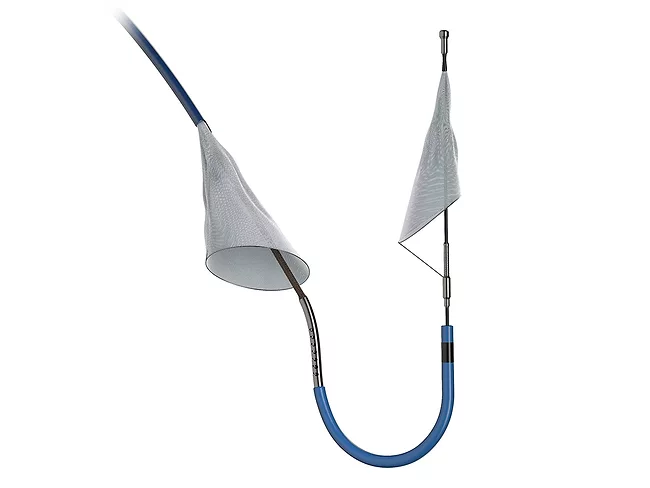
Few disease states in the world of cardiology have been studied as persistently as atrial fibrillation (AF), but new study data presented in Chicago at the 2022 scientific sessions of the American Heart Association seem to advance the cause of an ablation-first strategy for some patients experiencing paroxysmal AF. The PROGRESSIVE-AF study demonstrated that patients who are ablated early in the disease cycle are less likely than those placed on drug management to experience recurrence and to be readmitted, just two of several findings that are driving cardiologists toward device therapy and away from drug therapy for their patients with AF.
Medtronic plc reported six-month results from the full cohort of its Spyral HTN-ON MED study, showing a statistically significant reduction in office-based blood pressure, a key secondary endpoint. However, the trial missed its primary efficacy endpoint of a reduction in 24-hour systolic blood pressure, compared with a sham procedure.
Boston Scientific Corp. and Abbott Laboratories continue to parry over clinical trials comparing the latter’s Amplatzer Amulet with Boston Scientific’s Watchman in sealing the heart’s left atrial appendage (LAA) to prevent ischemic stroke in patients with atrial fibrillation (Afib). In one of five presentations at the 34th Transcatheter Cardiovascular Therapeutics annual scientific symposium in Boston in mid-September, Abbott said device-related thrombosis or peri-device leak more frequently preceded strokes in patients with Watchman compared to those with Abbott’s Amplatzer Amulet device.
Abiomed Inc., has worked the ventricular assist device (VAD) space for a number of years with its Impella series of VADs, and a study coming out of Japan seems to affirm investors’ confidence in these devices. This registry study demonstrated that the combination of Impella devices and extracorporeal membrane oxygenation (ECMO) provides a 30-day survival rate of more than three in four patients with cardiogenic shock, an outcome that is said to support the notion that the native heart tissue can recover from myocarditis, an especially salient consideration for those who contracted the SARS-CoV-2 virus.
Boston Scientific Corp.’s Sentinel cerebral protection system missed its primary endpoint of reduced stroke in the PROTECTED TAVR clinical trial. The data did, however, show a significant reduction in risk of disabling stroke in the immediate days after a transcatheter aortic valve replacement (TAVR) procedure.
One of the biggest stories coming out of Transcatheter Cardiovascular Therapeutics’ annual meeting in Boston this weekend focuses on the success of Edwards Lifesciences Corp.’s freshly FDA-approved Pascal Precision transcatheter valve repair system in the CLASP IID trial, which compared it to Abbott Laboratories’ Mitraclip device in patients with degenerative mitral regurgitation (DMR) who were determined to be at prohibitive surgical risk.
Despite wide availability and coverage for colonoscopy, many patients diagnosed with colorectal cancer (CRC) have never undergone the recommended screening procedure for the malignancy and its precursors. As a result, the cancer has already spread in the majority of cases at the time of diagnosis. CRC remains the third most common cancer diagnosed in the U.S. and the second leading cause of cancer death for both men and women.
Some of the most exciting news out of the European Society for Medical Oncology Congress 2022 in Paris surrounded the rapidly evolving field of multi-cancer early detection (MCED), which offers the dual benefits of identifying malignancies at a more easily treated local stage and enabling screening for the 70% of cancers that lack recommended screening tests.
The U.S. FDA may be the most advanced regulatory agency when it comes to artificial intelligence (AI) and machine learning (ML), but developers of these products still have little in the way of FDA guidance to work with in many instances. Cassie Scherer of Dublin-based Medtronic plc, told attendees at this year’s Food and Drug Law Institute annual conference that they should have a product change control protocol ready to go despite the absence of FDA guidance on the subject, an effort that will increase time to market but pay eventually big dividends.
For a non-invasive cancer, ductal carcinoma in situ (DCIS) has spread rapidly—at least in research studies. Multiple companies presented results of diagnostic tests and genomic analysis that offer guidance for selecting treatment options for stage 0 breast cancer at the 2022 American Society of Clinical Oncology (ASCO) annual meeting, which concluded in Chicago on June 7. Several of these studies reliably predicted which patients can safely be selected for active surveillance without surgery, who would benefit from endocrine or radiotherapy following surgery and who would be best served by risk-reducing surgery such as double mastectomy.