Most patients with non-small-cell lung cancer (NSCLC) develop acquired drug resistance to EGFR inhibitors. Osimertinib, a third-generation inhibitor, often sees its therapeutic effect reduced due to the C797S mutation of EGFR exon 20, which blocks the binding of Cys797 to osimertinib.
Researchers at Dana-Farber Cancer Institute are advancing a fourth-generation allosteric EGFR inhibitor, EAI-432, to treat non-small-cell lung cancer driven by mutations in the EGFR gene, particularly the L858R mutation.
Blueprint Medicines Corp. has synthesized EGFR (HER1; erbB1) inhibitors reported to be useful for the treatment of cancer, particularly non-small-cell lung cancer.
Scorpion Therapeutics Inc. has disclosed tetrahydroindole derivatives acting as EGFR (HER1; erbB1) and/or HER2 (erbB2) inhibitors reported to be useful for the treatment of cancer.
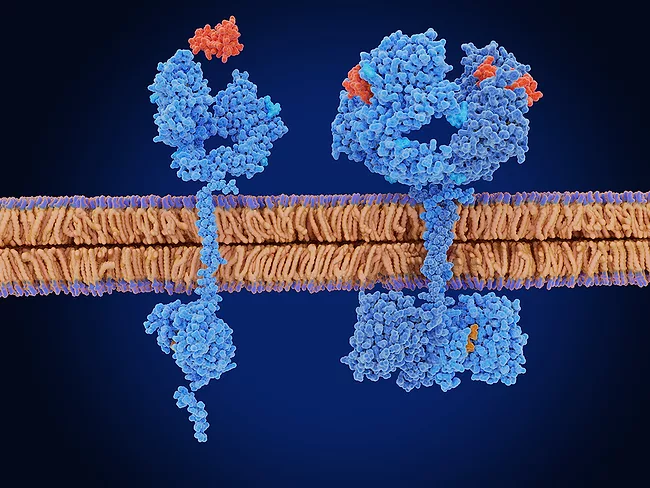
Epidermal growth factor receptor (EGFR) is involved in cell proliferation leading to malignant transformation, and for that it is considered a therapeutic target for treatment and prevention in lung and other cancers.
Shanghai Lisen Imprinting Pharmaceutical Technology Co. Ltd. has disclosed EGFR (HER1; erbB1) inhibitors reported to be useful for the treatment of small-cell lung (SCLC) and l lung cancer (NSCLC).
Chia Tai Tianqing Pharmaceutical Group Co. Ltd. has identified EGFR (HER1; erbB1) wild-type and/or mutant inhibitors reported to be useful for the treatment of cancer, particularly non-small-cell lung cancer (NSCLC).


.webp?height=488&t=1677877909&width=650 "Epidermal growth factor receptor (EGFR)")