The shadow of two reported patients’ deaths hovers over Eisai Co Ltd. and Biogen Inc.’s Alzheimer’s disease treatment, lecanemab, as the companies prepare to present phase III study data on the drug later today at the 15th Clinical Trials on Alzheimer's Disease conference.
Researchers at the University of Cincinnati have published data showing that in patients with dominantly inherited Alzheimer’s disease-causing mutations, high levels of soluble amyloid-β42 (Aβ42) in the cerebrospinal fluid predicted a reduced risk of developing dementia over three years.
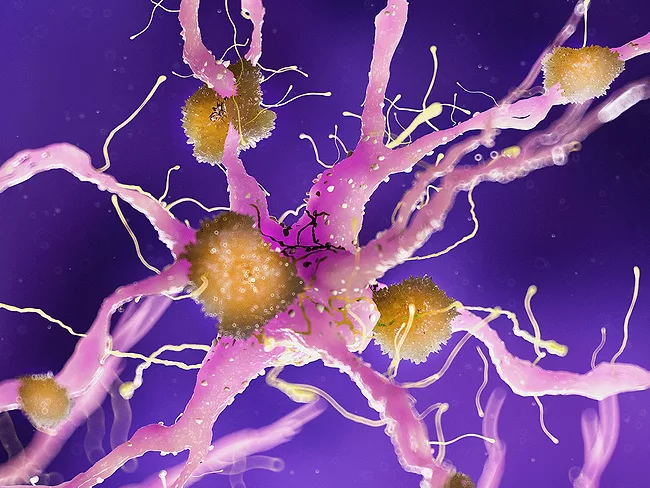
Researchers at the University of Cincinnati have published data showing that in patients with dominantly inherited Alzheimer’s disease (AD)-causing mutations, high levels of soluble amyloid-β42 (Aβ42) in the cerebrospinal fluid (CSF) predicted a reduced risk of developing dementia over 3 years. Their work, which appeared in the Oct. 4, 2022, print issue of the Journal of Alzheimer’s Disease after earlier publication online, suggests that the problem with amyloid in AD may be a lack of soluble amyloid-β, rather than a surfeit of plaques.
Analysts were upbeat about positive results from Eisai Co Ltd. and Biogen Inc.’s phase III confirmatory Clarity Alzheimer’s disease (AD) trial of lecanemab that met both primary and secondary endpoints, and most agreed that the data should be enough to gain FDA approval for mild cognitive impairment due to AD.
Analysts were upbeat about positive results from Eisai Co Ltd. and Biogen Inc.’s phase III confirmatory Clarity Alzheimer’s disease (AD) trial of lecanemab that met both primary and secondary endpoints, and most agreed that the data should be enough to gain FDA approval for mild cognitive impairment due to AD.
The pandemic has forced pharma and biotech to be more agile to better navigate the obstacles and still find success. Supply chain gaps are part of the problem, as are clinical trial delays. Yet the industry has successfully forged ahead in the past year to produce the seven drugs Clarivate believes in the next five years will each earn more than $1 billion annually.
Just months after the controversial FDA approval of Alzheimer’s disease drug Aduhelm (aducanumab), partners on that medicine, Eisai Co. Ltd. and Biogen Inc., are advancing a BLA for another possible AD therapy, lecanemab. Formerly known as BAN-2401, the Bioarctic AB-originated antibody is designed to neutralize and eliminate soluble, toxic amyloid beta for the treatment of early AD. The rolling submission, in pursuit of an accelerated approval, was primarily based on data from a phase IIb trial in people with early AD and confirmed amyloid pathology.
New FDA breakthrough therapy designations awarded for two investigational Alzheimer's disease (AD) candidates, Eli Lilly and Co.'s donanemab and the Bioarctic AB-Eisai Co. Ltd.-developed asset lecanemab (BAN-2401) underline ongoing willingness at the U.S. regulator to invest deeper attention in the potential of amyloid plaque reduction to slow progress of the disease, a critical and costly challenge estimated to affect more than 6 million Americans.
New FDA breakthrough therapy designations awarded for two investigational Alzheimer's disease (AD) candidates, Eli Lilly and Co.'s donanemab and the Bioarctic AB-Eisai Co. Ltd.-developed asset lecanemab (BAN-2401) underline ongoing willingness at the U.S. regulator to invest deeper attention in the potential of amyloid plaque reduction to slow progress of the disease, a critical and costly challenge estimated to affect more than 6 million Americans.