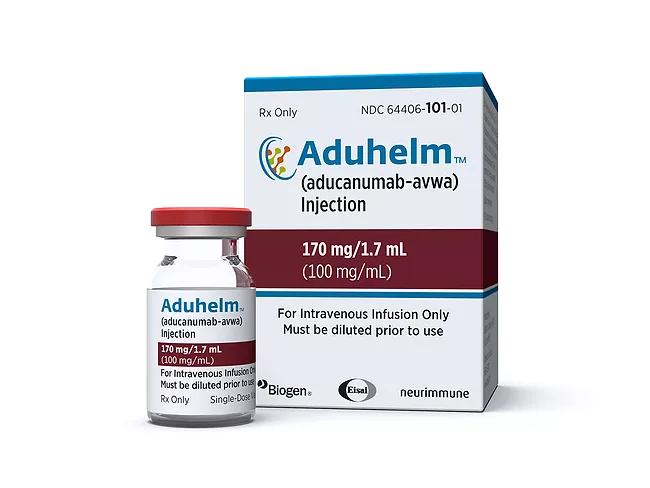
European regulators have put off a decision on Biogen Inc and Eisai, Co. Ltd.’s controversial Alzheimer’s drug, aducanumab, for likely another month, after the companies announced further supportive data from a follow-up under review by the FDA.
Just months after the controversial FDA approval of Alzheimer’s disease drug Aduhelm (aducanumab), partners on that medicine, Eisai Co. Ltd. and Biogen Inc., are advancing a BLA for another possible AD therapy, lecanemab. Formerly known as BAN-2401, the Bioarctic AB-originated antibody is designed to neutralize and eliminate soluble, toxic amyloid beta for the treatment of early AD. The rolling submission, in pursuit of an accelerated approval, was primarily based on data from a phase IIb trial in people with early AD and confirmed amyloid pathology.
New FDA breakthrough therapy designations awarded for two investigational Alzheimer's disease (AD) candidates, Eli Lilly and Co.'s donanemab and the Bioarctic AB-Eisai Co. Ltd.-developed asset lecanemab (BAN-2401) underline ongoing willingness at the U.S. regulator to invest deeper attention in the potential of amyloid plaque reduction to slow progress of the disease, a critical and costly challenge estimated to affect more than 6 million Americans.
The FDA’s recent release of documents related to its accelerated approval of Aduhelm (aducanumab) did little to reduce the controversy surrounding that decision and the U.S. pricing of Biogen Inc.’s Alzheimer’s drug.
New FDA breakthrough therapy designations awarded for two investigational Alzheimer's disease (AD) candidates, Eli Lilly and Co.'s donanemab and the Bioarctic AB-Eisai Co. Ltd.-developed asset lecanemab (BAN-2401) underline ongoing willingness at the U.S. regulator to invest deeper attention in the potential of amyloid plaque reduction to slow progress of the disease, a critical and costly challenge estimated to affect more than 6 million Americans.
Bristol Myers Squibb Co. (BMS) and Eisai Co. Ltd. inked a potential $3.1 billion agreement to co-develop and co-commercialize the antibody-drug conjugate (ADC) MORAb-202 for advanced solid tumors. Eisai’s first ADC, MORAb-202 pairs the company’s anti-folate receptor alpha (FRα) antibody with the Tokyo-based firm’s anticancer agent eribulin using an enzyme cleavable linker. It is characterized as a potential best-in-class candidate and is under investigation for tumors that include endometrial, ovarian, lung and breast cancers in two studies: a phase I effort in Japan and a phase I/II experiment in the U.S. The companies plan to enter the registrational stage of development as early as 2022.
PERTH, Australia – Digital cognitive assessment technology company Cogstate Ltd. saw its stock skyrocket 60% on the heels of FDA accelerated approval of Biogen Inc./Eisai Co. Ltd.’s Alzheimer’s disease drug Aduhelm (aducanumab). Cogstate and Eisai signed a deal in October 2020 that granted Eisai global development rights and exclusive commercialization rights of all cognitive function tests developed by Cogstate.
With 10 cases of serious shock and anaphylaxis, including one death, in the month since Seikagaku Corp.’s osteoarthritis drug, Joyclu (diclofenac etalhyaluronate sodium), launched in Japan, the Pharmaceuticals and Medical Devices Agency (PMDA) issued a blue letter to health care professionals and is adding a warning section to the drug’s Japanese label.
In an unusual move, three members of the Nov. 6 FDA advisory committee that voted against recommending approval of Biogen Inc.’s high profile Alzheimer’s disease candidate, aducanumab, have doubled down on their argument in an editorial published in JAMA on March 31.
HONG KONG – Eisai Co. Ltd. has received not one, but two approvals from Japan’s Ministry of Health, Labour and Welfare (MHLW), for its anticancer agent Remitoro (denileukin diftitox) and multiple receptor tyrosine kinase inhibitor Lenvima (lenvatinib mesylate).