Researchers from George Washington University filed for protection of a system and method that leverages generative models, specifically Variational Autoencoders, to conduct functional connectivity analysis from functional magnetic resonance imaging scans.
The U.K. Medicines and Healthcare Products Regulatory Agency (MHRA) unveiled the pilot version of its AI Airlock in 2024, and the agency posted a list of the products that are taking part in this version of a regulatory sandbox.
Insilico Medicine founder and CEO Alex Zhavoronkov told BioWorld that he tries to spend as much time as possible in China, because that's where the artificial intelligence (AI) drug development company conducts synthesis and tests for early stage discovery. “And nowadays, not a day goes by without somebody launching an AI drug discovery company,” he said, noting that Chinese AI company Deepseek could be a huge disrupter.
Insilico Medicine founder and CEO Alex Zhavoronkov told BioWorld that he tries to spend as much time as possible in China, because that's where the artificial intelligence (AI) drug development company conducts synthesis and tests for early stage discovery. “And nowadays, not a day goes by without somebody launching an AI drug discovery company,” he said, noting that Chinese AI company Deepseek could be a huge disrupter.
South Korea’s Ministry of Food and Drug Safety said it released the world’s first guideline on reviewing and approving generative artificial intelligence-based medical devices Jan. 24, to help establish standards on the technology’s applications in the medical field.
South Korea’s Ministry of Food and Drug Safety said it released the world’s first guideline on reviewing and approving generative artificial intelligence-based medical devices Jan. 24, to help establish standards on the technology’s applications in the medical field.
Insilico Medicine Inc. nabbed a potential $550 million-plus deal with Menarini Group’s Stemline Therapeutics Inc. for an unnamed preclinical small-molecule drug targeting solid tumors, adding to a $500 million deal inked by the duo in January 2024.
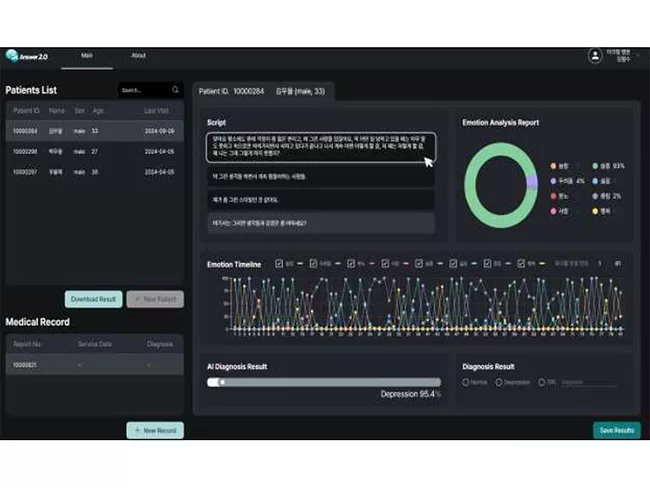
South Korea’s Ministry of Food and Drug Safety cleared Acryl Inc.’s Acryl-D01 as the country’s first AI-based digital therapeutic software solution to aid depression screening and diagnosis on Dec. 20. Approved as a class II software as a medical device, Acryl-D01 utilizes a patient’s medical records to quantify and analyze the individual’s emotional response and assess the probability of having clinical depression based on the data.
The health care potential for generative artificial intelligence comes with hazards such as the inadvertent effects of poor prompt engineering practices, but Anil Bhatta of Deloitte Consulting told a U.S. FDA advisory committee that this risk could be managed by rules that would thwart any consequent problems, such as an inadvertent jailbreak of the algorithm’s intended use.
The first day of the U.S. FDA’s two-day advisory hearing on generative artificial intelligence reflected some of the anxieties attached to this emerging technology, with the phenomenon of hallucinations driving several calls for more stringent regulation of this class of products that might be applied toward other entries in the class of artificial intelligence.