Amgen Inc. reported its latest financial numbers but much of the conversation on the Feb. 6 conference call was about obesity. The same was true with Eli Lilly and Co. as weight loss drove the narrative.
The landscape of biopharma deals and M&As has seen a transformative shift, with a year-over-year drop in transaction numbers while value has increased. Overall, biopharma deals saw an uptick in value of nearly 6%, and biopharma M&As concurrently soared 80% higher in value than the previous year.
The U.S. Patent and Trademark Office (USPTO) published new enablement guidelines Jan. 10 to provide more consistency across technologies to ensure patent applications truly enable the breadth of their claims in keeping with the Supreme Court’s unanimous decision last year in Amgen Inc. v. Sanofi SA.
The U.S. Patent and Trademark Office (USPTO) published new enablement guidelines Jan. 10 to provide more consistency across technologies to ensure patent applications truly enable the breadth of their claims in keeping with the Supreme Court’s unanimous decision last year in Amgen Inc. v. Sanofi SA.
Biosimilars grabbed a lot of headlines in 2023, thanks to the biggest U.S. biosimilar launch to date targeting Abbvie Inc.’s mega-blockbuster Humira (adalimumab). Eight biosimilars referencing the immunology drug entered the U.S. market under licensing agreements with Abbvie. Amgen Inc.’s Amjevita led the pack with a five-month headstart in January. The others – including the first adalimumab interchangeable, Boehringer Ingelheim GmbH’s Cyltezo – launched in July.
Postera Inc. has announced a multitarget collaboration with Amgen Inc. that seeks to leverage Postera’s artificial intelligence (AI) platform, Proton, an innovation in generative chemistry and synthesis-aware design, and Amgen’s drug discovery expertise, to advance up to five small-molecule programs.
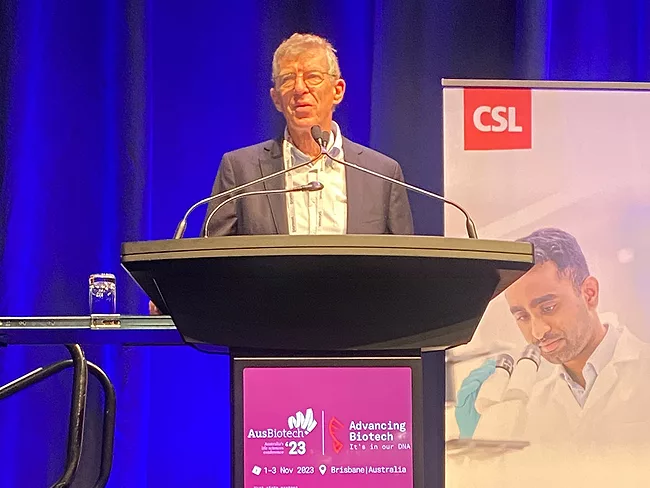
What’s it going to take for Australia’s biotech industry to be more self-sufficient? Although Australia is far away from the rest of the world, no one is an island when it comes to biotechnology, Ausbiotech CEO Lorraine Chiroiu said during the Ausbiotech 2023 conference held in Brisbane Nov. 1-3. Investors gathered to riff about what they were looking for in Australian biotech investments and what needs to change for the sector to be sustainable. All agreed that the science in Australia is top-notch but that the ecosystem needs more investment to be competitive.
What’s it going to take for Australia’s biotech industry to be more self-sufficient? Although Australia is far away from the rest of the world, no one is an island when it comes to biotechnology, Ausbiotech CEO Lorraine Chiroiu said during the Ausbiotech 2023 conference held in Brisbane Nov. 1-3. Investors gathered to riff about what they were looking for in Australian biotech investments and what needs to change for the sector to be sustainable. All agreed that the science in Australia is top-notch but that the ecosystem needs more investment to be competitive.
Instead of the two-step process that’s been the typical path for interchangeables in the U.S., Amgen Inc.’s Wezlana got a green light Oct. 31 from the FDA as both the first approved biosimilar and interchangeable to Johnson & Johnson’s inflammatory disease drug, Stelara (ustekinumab).
More layoffs are coming at Amgen Inc., which said it plans to cut about 350 positions from newly acquired Horizon Therapeutics plc. The announcement marks the company’s third round of cutbacks for 2023, following 300 employees in January and another 450 in March, and comes a few weeks after closing on the $27.8 billion buyout.