Harpoon Therapeutics Inc. provided updated interim monotherapy data from 71 patients in its phase I/II trial testing HPN-328 in small-cell lung cancer (SCLC) and other neuroendocrine tumor types in a poster at the European Society of Medical Oncology Congress (ESMO). Wall Street immediately began comparing the compound, which takes aim at delta-like ligand 3 (DLL3) with a similar prospect from Amgen Inc. that recently yielded promising results.
Biopharma companies and industry advocates received the message the U.S. FTC intended to send when it broke new antitrust ground earlier this year in challenging Amgen Inc.’s $27.8 billion acquisition of Horizon Therapeutics plc. Now they’re uniting to send a message of their own – in the guise of an awareness campaign showing that the FTC’s new approach to M&A reviews and antitrust enforcement will undermine the ecosystem responsible for innovative and important therapies the world over.
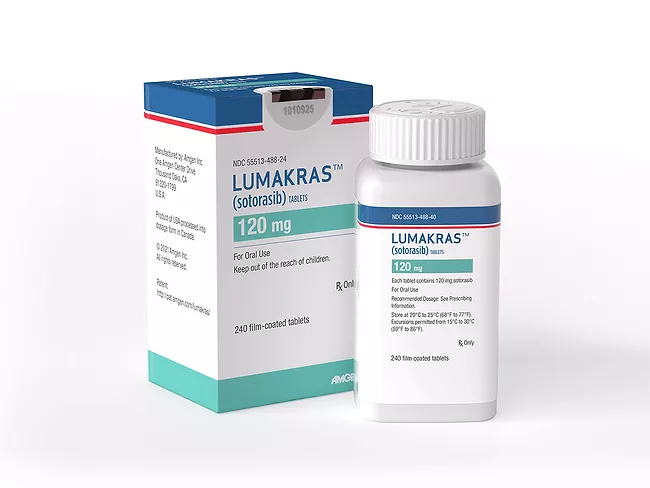
The dark cloud of what the U.S. FDA called potential “systemic bias” rained on Amgen Inc.’s bid for full approval of Lumakras (sotorasib), a KRAS-G12C inhibitor that was granted accelerated approval in May 2021 for locally advanced or metastatic non-small-cell lung cancer after at least one systemic therapy.
Bad news for Amgen Inc. could mean upside for Mirati Therapeutics Inc., though the meeting of the U.S. FDA’s Oncologic Drugs Advisory Committee (ODAC) has yet to tell the tale regarding Lumakras (sotorasib), the former’s KRAS-G12C inhibitor.
As biosimilar development expands beyond monoclonal antibodies to more complex biologics, the flexibility built into regulatory paths across the world will become more essential. Rather than making wholesale changes to those pathways, regulators need to follow the science in exercising the flexibility they already have, Leah Christl, executive director of global biosimilars regulatory affairs and R&D policy at Amgen Inc., told BioWorld. In doing so, “we do need to look forward to what might be coming down the pipeline,” in addition to looking backwards at what types of biosimilars have already been approved, she said.
If the U.S. FDA has its way, biosimilars and interchangeable biosimilars would no longer be a difference with a distinction – at least when it comes to labeling. Instead of distinguishing between the two, the agency is recommending that the labeling for both follow-ons include a “biosimilarity statement.”
Amgen Inc. has patented new quinazoline compounds acting as GTPase KRAS (G12D mutant) inhibitors and thus reported to be useful for the treatment of cancer.
Forget location. It’s timing, timing, timing when it comes to escaping the first round of U.S. Medicare price negotiations due to pending biosimilar competition. Under the Inflation Reduction Act (IRA), only single-source drugs that have been approved for a specific length of time are subject to the forced negotiations, which focus on drugs with the biggest Medicare spend, not necessarily the highest price tag. Since the IRA gives biologics a 12-year safe harbor from negotiations, which aligns with the biologic exclusivity provided by the Biologic Price Competition and Innovation Act, it creates a scenario in which the innovator could be facing negotiations just as its first biosimilar competition prepares to launch. That creates a lot of what-ifs.
Now that the U.S. FDA has nearly 15 years of experience with developing and implementing a biosimilar pathway, it’s time for that regulatory path to catch up with the science, according to experts that have been involved in biosimilar development even before Congress passed the Biologics Price Competition and Innovation Act that created the framework for the U.S. biosimilar market.