Biorchestra Co. Ltd. reached an exclusive research, option and licensing contract with a U.S.-based company to use its targeting technology platform to develop nucleic acid therapies to treat neurological disorders in a deal valued up to $861 million.
Junshi Biosciences Co. Ltd. and Rxilient Biotech Pte Ltd. are forming a joint venture (JV) to develop and commercialize Junshi’s PD-1 inhibitor, toripalimab, in nine Southeast Asian nations, including Thailand, Brunei, Cambodia, Indonesia, Laos, Malaysia, Myanmar, the Philippines and Vietnam.
Boehringer Ingelheim GmbH has agreed to pay Covant Therapeutics Inc. $10 million for exclusive rights to the latter’s ADAR1-targeting immuno-oncology program. Under the terms of the exclusive research collaboration and worldwide licensing agreement, newly unveiled drug discovery company Covant will carry out the preclinical work in creating an ADAR1 small-molecule inhibitor, with Boehringer offering its scientific expertise to help advance the program into the clinic.
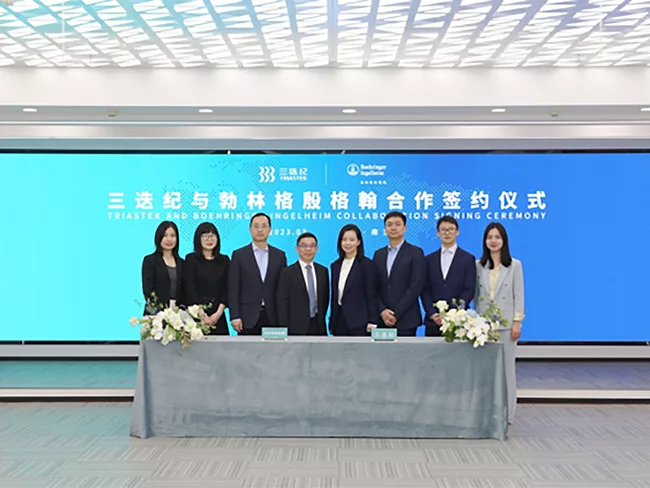
Triastek Inc., a digital pharmaceutical solutions company, is taking a unique approach by using 3D printing technology to develop a pipeline that spans rheumatoid arthritis (RA), clotting disorders, ulcerative colitis and pulmonary hypertension. Its technology was recently validated through a partnership with Boehringer Ingelheim GmbH. The company’s 3D printing products include T-19, T-20 and T-21, which have all received IND approval from the FDA.
Jounce Therapeutics Inc. is leaving Redx Pharma plc at the altar after deciding instead to merge with Concentra Biosciences LLC. In late February, Jounce had said it planned to merge with Redx in an all-share transaction that would have created a $425 million combined entity.
The increased availability of capital, greater access to talent, strong local governmental support and more focused attention on IP issues have increased the complexity of deals taking place between biotech and big pharma companies in China, according to Michelle Chan, chief business officer of Insilico Medicine Inc, who spoke in a panel discussion on the topic of Asia-Pacific partnering at this year’s Bio-Europe Spring, in Basel, Switzerland on March 21.
After Novartis AG decided not to take it forward in-house, the U.S. National Institute on Drug Abuse is to fund phase III development of mavoglurant in the treatment of cocaine abuse disorder. The agreement to back a trial involving up to 330 participants is with Stalicla SA, which in-licensed the glutamate receptor antagonist from Novartis earlier this year.
Biohaven Ltd. has acquired global rights, excluding China, from Highlightll Pharmaceutical Co. Ltd. to develop and commercialize a dual inhibitor of tyrosine kinase 2 (TYK2) and JAK1, BHV-8000 (TLL-041), for the treatment of brain disorders in a deal worth up to $970 million.
Just days after Karuna Therapeutics Inc. reported positive data from a third registrational trial of Karxt (xanomeline plus trospium) in schizophrenia, Puretech Health plc sold a portion of its royalty in Karxt in a potential $500 million agreement with Royalty Pharma. Puretech was a founder of Karuna and co-inventor of Karxt, an oral M1/M4-preferring muscarinic agonist.
 RSS
RSS