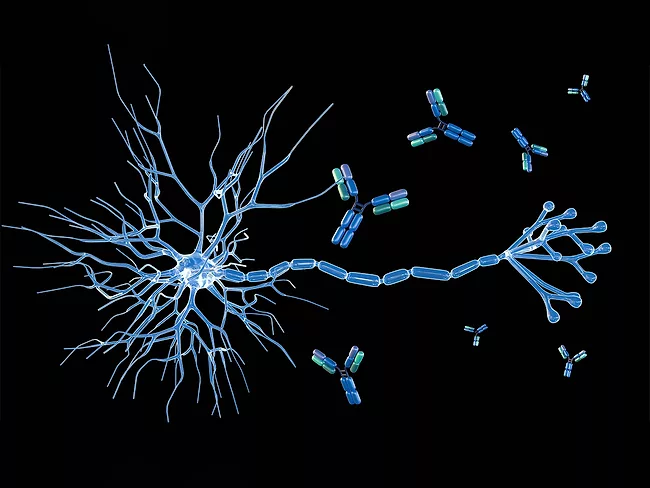
Certain cancers, such as triple-negative breast cancer, produce antibodies that, although they help fight the tumor, can cross the blood-brain barrier and alter the function of NMDA receptors (NMDAR) in the brain, which are essential for neuronal signaling. Scientists at Cold Spring Harbor Laboratory (CSHL) have identified their origin and described how this process is linked to the maturation of these antibodies, which can activate or inhibit the receptor, causing neurological and psychiatric symptoms.
Nanjing Sanhome Pharmaceutical Co. Ltd. has synthesized new Werner syndrome ATP-dependent helicase (WRN; RECQ3; RECQL2) inhibitors potentially useful for the treatment of cancer.
A University of Texas System patent describes new radiolabeled positron emission tomography (PET) imaging agents targeting receptor-interacting serine/threonine-protein kinase 1 (RIPK1; RIP-1). As such, they are potentially useful for the diagnosis of cancer, retinal and autoimmune diseases, neurological and inflammatory disorders.
Researchers from Blueprint Medicines Corp. and F. Hoffmann-La Roche Ltd. presented the preclinical characterization of BLU-852, a selective MAP4K1 inhibitor developed as a potential immunotherapeutic agent for cancer treatment.
Using Iambic Therapeutics’ AI/HTE platform, researchers at the company have engineered a next-generation HER2 inhibitor with superb selectivity for HER2, as well as broad mutant coverage and brain penetrance. The compound, IAM-1363, binds to HER2 in a type II DFG-out conformation, which represents the first reported type II HER2 tyrosine kinase inhibitor.
In both acute myeloid leukemia (AML) and synovial sarcoma (SS), targeting BRD9 disrupts oncogenic transcriptional programs, including MYC, leading to reduced proliferation and induction of apoptosis. Researchers from Pamplona Therapeutics (Shenzhen) Co. Ltd. reported the discovery and preclinical efficacy profile of XYD-270, a BRD9-targeting PROTAC, in models of SS and AML.
The use of CAR T-cell therapy has transformed outcomes for relapsed or refractory B-cell malignancies, but access to it remains extremely limited in some countries. Cartogene Therapeutics Pvt Ltd. aimed to address this need by in-licensing CGT-19, a CD19 CAR T construct from Vector Biomed Inc.
Forx Therapeutics AG presented a comprehensive preclinical medicinal chemistry and translational profiling program describing the optimization of potent and selective poly(ADP-ribose) glycohydrolase inhibitors, which led to the identification of FORX-428, currently in phase I clinical trials. The company also disclosed the chemical structure of the compound.
Chengdu Sibeibo Pharmaceutical Technology Co. Ltd. has reported new poly(ADP-ribose) polymerase 14 (PARP-14; ARTD8) inhibitors potentially useful for the treatment of cancer, asthma, atopic dermatitis and infectious pneumonia.
 RSS
RSS