PARIS – Researchers at the Biomechanics and Bioengineering laboratory (BMBI), a joint venture between the Compiègne University of Technology in Oise, France, and the National Center for Scientific Research (CNRS), have designed a new implant intended for minimally invasive surgery for mitral valve repair. One of the BMBI teams has been working closely two cardiovascular surgeons from the University Hospital of Henri-Mondor to develop this new minimally invasive approach in the treatment of mitral valve regurgitation.
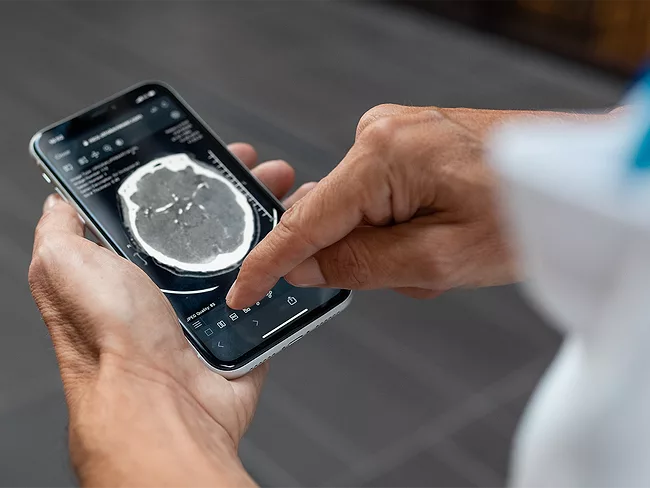
For the 795,000 Americans who suffer a stroke each year, time is brain. The U.S. FDA granted 510(k) clearance to a solution the developer says could cut time-to-treatment in stroke by an hour, preserving 3.6 years of healthy life. Nico.lab’s artificial intelligence-based CT scan analyzer, Strokeviewer LVO, uses an algorithm that enables faster triaging of stroke patients and enables physicians to see the location of occlusions in minutes.
Livanova plc has inked an agreement with Gyrus Capital SA to divest its heart valve business. The sale has an enterprise value of €60 million (US$73 million) and is expected to wrap up in the first half of next year. The Livanova board has already given its unanimous assent for the deal. Livanova now expects to strengthen its focus on its neuromodulation and cardiovascular platforms.
PARIS – Corwave SA has obtained $600,000 as part of the Ile-de-France region's stimulus plan, to boost development of its Neptune cardiac support pump. This subsidy is part of the manufacturing recovery plan for the Ile-de-France region, aimed at very small enterprises (VSEs), small and medium-sized enterprises (SMEs) and mid-cap companies. In the midst of the COVID-19 pandemic, the Ile-de-France Region is supporting re-industrialization in a region that brings together 12.1 million inhabitants, or nearly 19% of the French population.
The drug-eluting balloon (DEB) has not displaced the drug-eluting stent (DES) for treatment of infarcts, but that may be changing with the results of the PICCOLETO II study.

 RSS
RSS