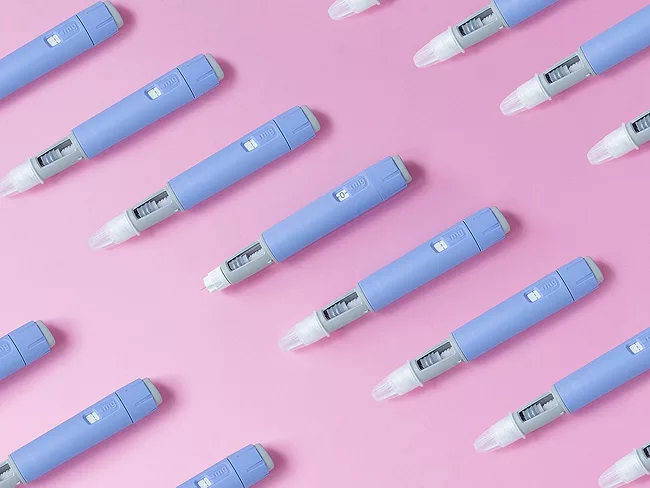
Two leading glucagon-like peptide-1 (GLP-1) receptor agonists for obesity and type 2 diabetes – Novo Nordisk A/S’s semaglutide (Wegovy/Ozempic) and Eli Lilly and Co.’s tirzepatide (Mounjaro/Zepbound) – are advancing in China after taking the U.S. market by storm.
As Novo Nordisk A/S and Eli Lilly and Co. go head-to-head in the U.S. and Chinese glucagon-like peptide-1 receptor agonists (GLP-1RA) market for diabetes and obesity, Novo Nordisk is in innovator gear once more with leading studies of GLP-1s in Alzheimer’s disease.
Chinese pharmaceutical and biotech companies are leading development of glucagon-like peptide-1 receptor agonists as Novo Nordisk A/S and Eli Lilly and Co. edge closer to launching blockbuster therapies in China. At the heart of the GLP-1 boom is a nationwide obesity problem driven by a confluence of factors, including the rise of a modern, sedentary lifestyle, according to Clarivate. Despite the rising prevalence of obesity and type 2 diabetes, the gap in obesity therapeutics is “substantial and leaves a solid market opportunity for weight loss drugs,” Karan Verma, principal analyst of healthcare research & data analytics at Clarivate, said.
Yoltech Therapeutics Co. Ltd. licensed its PCSK9-targeting gene editing therapeutic, YOLT-101, to Shenzhen Salubris Pharmaceuticals Co. Ltd. for mainland China rights in a deal worth ¥1.035 billion (US$145 million).
Yunovia Co. Ltd. gained clearance in South Korea to start a multiple ascending dose phase I study for ID-110521156 – a novel, orally available, small-molecule, glucagon-like peptide-1 (GLP-1) agonist.
Visen Pharmaceuticals Co. Ltd.’s palopegteriparatide met both primary and secondary endpoints in the phase III Pathway trial conducted in China in adults with chronic hypoparathyroidism, according to top-line data. In the 26-week randomized, double-blind, placebo-controlled Pathway trial, 77.6% of patients treated with palopegteriparatide achieved the primary multicomponent endpoint compared to 0% for placebo.
Tokyo-headquartered Otsuka Pharmaceutical Co. Ltd. said Aug. 1 that it will acquire Boston-based Jnana Therapeutics Inc. through a potential $1.125 billion M&A deal. Under the terms, Otsuka will work to close the transaction by the third quarter of 2024, with $800 million paid out to Jnana shareholders, along with up to $325 million in additional development and regulatory milestones payments.
Three Chinese biopharmaceuticals have filed for IPOs on the Hong Kong exchange in July alone, highlighting a potential “newfound positivity” to strengthen the HKEX IPO market in the second half of 2024.
Gan & Lee Pharmaceuticals’ long-acting GLP-1 receptor agonist (GLP-1 RA), GZR-18, achieved as much as 17.29% weight loss in a phase IIb trial in obese and overweight Chinese patients. Developed independently by Shanghai-based Gan & Lee, GZR-18 is a once-weekly or potentially biweekly GLP-1 RA being developed to treat adults with type 2 diabetes and for weight management for obese or overweight patients.
Innovent Biologics Inc.’s glucagon-like peptide-1 receptor (GLP-1R) and glucagon receptor (GCGR) dual agonist, mazdutide, met the primary endpoint and all key secondary endpoints in a phase III type 2 diabetes trial in Chinese adults. “Mazdutide is the first and fastest-developed GLP-1R/GCGR dual agonist in the world, and we are actively promoting the development of mazdutide for weight loss, T2D and other indications,” Lei Qian, Innovent’s vice president of clinical development, said.
 RSS
RSS