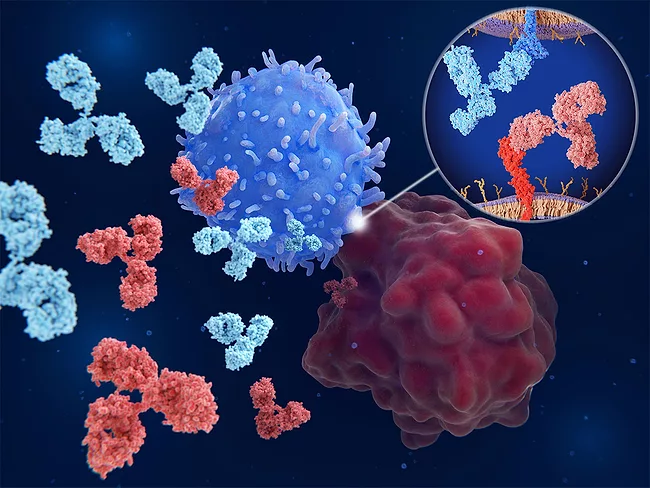
Coming off a presentation at the European Alliance of Associations for Rheumatology meeting, where a single report of disease recurrence in a lupus patient overshadowed promising early data for Kyverna Therapeutics Inc.’s autoimmune candidate, KYV-101, the Emeryville, Calif.-based company rallied on news of a case report describing the first use of the CD19-targeting CAR T-cell therapy in a patient with stiff-person syndrome, a rare, progressive neurological autoimmune disorder for which there is limited treatment.
Preliminary data show Biotron Ltd.’s lead compound BIT-225 met the primary objectives of the phase II BIT225-011 trial, a longitudinal, open-label trial designed to characterize the effect of the compound added to ongoing, suppressive antiretroviral therapy in HIV-1-infected, treatment-experienced patients who achieved only partial immune reconstitution.
The adverse effects of PD-1 blockers on the CNS observed in cancer patients could occur through their effects on an enzyme that activates microglia. Pharmacological inhibition of the enzyme in mice reduced microglial activation and cognitive deficit without altering the antitumor capacity of the immunotherapy.
At the recent EULAR meeting, a presentation by Nanjing Leads Biolabs Co. Ltd. covered the discovery of LBL-047, a novel bifunctional fusion protein targeting both plasmacytoid dendritic cells (pDCs) and B cells; it is being developed for the treatment of autoimmune diseases.
Following a day of deals that collectively bring a potential $3.75 billion into three biopharma companies – namely Ascidian Therapeutics Inc., Belharra Therapeutics Inc. and Mabcare Therapeutics – researchers will be busy discovering new therapies for neurological and immunological diseases, and advancing globally a candidate for solid tumors.
KYV-201 is an investigational allogeneic anti-CD19 CAR T-cell therapy candidate being developed by Kyverna Therapeutics Inc. for the treatment of B-cell-driven autoimmune diseases.
The adverse effects of PD-1 blockers on the CNS observed in cancer patients could occur through their effects on an enzyme that activates microglia. Pharmacological inhibition of the enzyme in mice reduced microglial activation and cognitive deficit without altering the antitumor capacity of the immunotherapy.
Optimism on Wall Street proved wise and shares of Mirum Pharmaceuticals Inc. (NASDAQ:MIRM) rose accordingly to close June 17 at $33, up $7.08, or 27.3%, as the firm disclosed interim results from two phase IIb studies evaluating volixibat, an oral ileal bile acid transporter (IBAT) inhibitor, in patients with primary biliary cholangitis (PBC) and primary sclerosing cholangitis (PSC). The drug proved its mettle in both liver biliary tract-stenosing indications, with no new safety signals turning up, Foster City, Calif.-based Mirum said.
The immune cell restricted guanine nucleotide exchange factor (GEF) and scaffolding protein VAV1 plays a key role in mediating T-cell receptor (TCR) and B-cell receptor (BCR) activity and signaling.
Vyrnwy Therapeutics Inc. has disclosed non-receptor tyrosine-protein kinase TYK2 inhibitors reported to be useful for the treatment of autoimmune diseases.

 RSS
RSS