Guangdong Fapon Biopharma Inc. has obtained IND clearance from the FDA for FP-008, its first-in-class immunocytokine for patients with solid tumors refractory to anti-PD-1 therapy.
Inflammatory diseases specialist AB2 Bio Ltd. has signed a potential $686 million U.S. commercialization deal for its interleukin-18 neutralizing drug tadekinig. The agreement with Japanese pharma company Nippon Shinyaku Co. Ltd. includes an initial payment of $6 million, with a further $30 million due later this year.
A year after Generate Biomedicines Inc. pulled off its $273 million series C financing round, the Flagship Pioneering-spawned and AI-powered protein therapeutics firm drew investment of an undisclosed amount from the Samsung Life Science Fund Dec. 18.
Takeda Pharmaceutical Co. Ltd. is licensing Keros Therapeutics Inc.’s activin inhibitor elritercept in a global development and commercialization deal worth up to $1.3 billion that excludes mainland China, Hong Kong and Macau.
Apollo Therapeutics Group Ltd. and Sunshine Lake Pharma Co. Ltd. inked a potential $938 million licensing deal for APL-18881 (HEC-88473), Sunshine’s dual fibroblast growth factor 21 (FGF21)/glucagon-like peptide-1 (GLP-1) receptor agonist currently in a phase II study for type 2 diabetes.
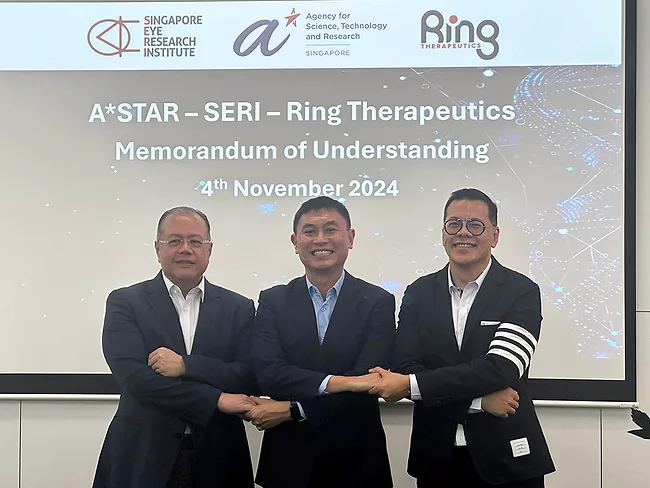
Ring Therapeutics Inc. has joined forces with Singapore’s Agency for Science, Technology, and Research and with the Singapore Eye Research Institute to advance the first new class of viral vectors in more than 50 years, Ring CEO Tuyen Ong told BioWorld.
When Andrew Wilks invented the JAK inhibitor momelotinib in the late 1980s for myelofibrosis, he never would have imagined it would take more than 20 years to develop and eventually be acquired for $1.9 billion. Today he’s on a mission to ensure Australian inventors have more options than he did, telling BioWorld that he had to sell the molecule for around $10 million because he couldn’t get funding.
David Baker, Demis Hassabis and John Jumper share the 2024 Nobel Prize in Chemistry for their contributions to the science of protein structure. David Baker was awarded half the prize “for computational protein design,” according to the Royal Swedish Academy of Sciences. Hassabis and Jumper shared the other half “for protein structure prediction.”
David Baker, Demis Hassabis and John Jumper share the 2024 Nobel Prize in Chemistry for their contributions to the science of protein structure. David Baker was awarded half the prize “for computational protein design,” according to the Royal Swedish Academy of Sciences. Hassabis and Jumper shared the other half “for protein structure prediction.”
Two weeks after reporting positive top-line results in first-line head and neck cancer with its lead candidate, eftilagimod alfa, in combination with Merck & Co. Inc.’s Keytruda (pembrolizumab), Immutep Ltd. presented updated data indicating the treatment could offer a non-chemotherapy option for patients with negative PD-L1 expression. Data from cohort B of the Tacti-003 (Keynote-PNC-34) phase IIb trial, which included 31 evaluable patients with PD-L1 expression of less than 1, as measured by Combined Proportion Score, showed a 35.5% objective response rate per RECIST 1.1 assessment.
 RSS
RSS