Elekta AB received U.S. FDA clearance for what it called a “groundbreaking upgrade” of its MR-Linac platform which can continuously calculate the movement of a tumor anywhere in the body. The company said the Elekta Unity’s comprehensive motion management platform provides clinicians with enhanced, adaptive radiation therapy workflow to track moving organs such as the prostate, liver and pancreas.
Perspectum Ltd. raised $19 million in the second close of its series C funding round bringing the total amount raised in the round to $55 million. The fundraising was led by Oppenheimer & Co. Inc., which sees the potential for long-term growth in Perspectum’s imaging and diagnostic technologies and invested $27 million.
Even its name is a testament to how enigmatic the tingible macrophage has been. Tingible, which means stainable, certainly gives no clues to its functions – but was, at least, one thing that was known about the cells. Now, scientists at the Garvan Institute of Medical Research have tracked the lifecycle and function of tangible macrophages in the lymph nodes, with implications for understanding autoimmune disorders, which are still poorly understood. Published March 2, 2023, in the journal Cell, the study highlights intravital imaging techniques the scientists used to observe how macrophages formed within the lymph nodes and how they behaved in real time.
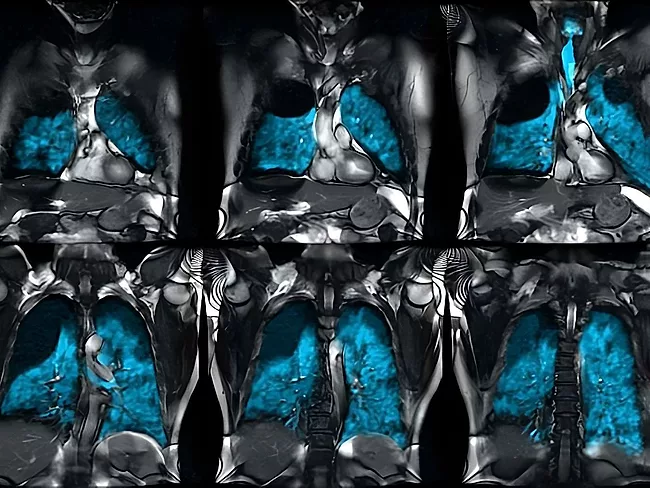
The U.S. FDA has approved Polarean Imaging plc’s drug-device combination product, Xenoview, for use with magnetic resonance imaging (MRI) in evaluating lung ventilation in adults and children aged 12 and older. The hyperpolarized contrast agent, which is prepared from the Xenon Xe 129 gas blend, is expected to be commercially available in the U.S. starting next month.
Researchers from the University of Saskatchewan have developed a novel theranostic candidate, [67Cu]EB-TATE, as an alternative to [177Lu]DOTATATE, for the imaging of gastroenteropancreatic neuroendocrine tumors (GEP-NET). EB-TATE, which is a derivative of octreotate with evans blue (EB), was radiolabeled with electron linear accelerator-produced 67CuCl2.
Researchers from Helmholtz-Zentrum Dresden-Rossendorf presented the discovery of novel small molecule-based radiotracers for PD-L1 PET or SPECT imaging.
Rational drug design based on EPI-X4, endogenous antagonist of C-X-C motif chemokine receptor (CXCR4), led to the identification of optimized analogues named JMF-01 to JMF-07, which demonstrated increased antagonistic activity.
The Massachusetts Institute of Technology (MIT) has developed collagen mimetic peptides for PET imaging to detect idiopathic pulmonary fibrosis (IPF), with [68Ga]DOTA-CMP showing selective identification of fibrotic collagen in vivo.
 RSS
RSS