GE Healthcare Ltd. is expanding its cancer technology capabilities through new alliances with artificial intelligence (AI) companies and researchers. The company said it is teaming up with U.K.-based Optellum Ltd. to advance lung cancer diagnostics, as well as collaborating with the University of Cambridge to develop an AI application that integrates cancer patient data from multiple sources into a single interface.
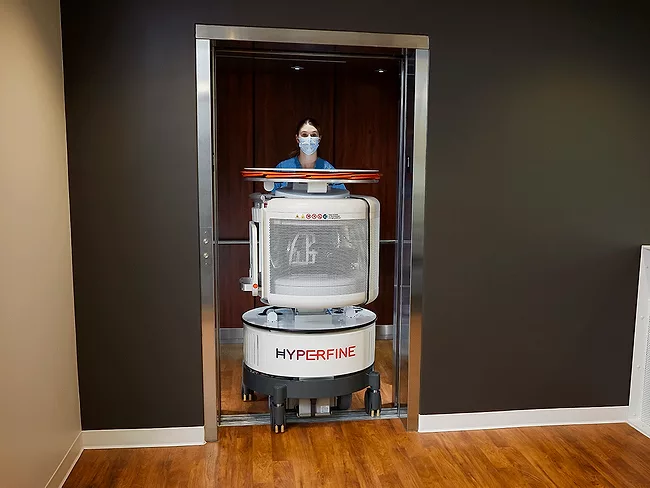
The FDA cleared Hyperfine Research Inc.’s advanced image reconstruction technology using deep learning for its portable magnetic resonance imaging device, Swoop. The bedside MRI unit’s artificial intelligence application received clearance in January and is used with deep learning to improve image quality and diagnostic value. Hyperfine and Liminal Sciences Inc., which share a founder in serial entrepreneur Jonathan Rothberg, are both combining with special purpose acquisition company Healthcor Catalio Acquisition Corp. to go public in a deal valued at $580 million. The companies reported on Nov. 29 that the Securities and Exchange Commission declared the registration statement on form S-4 for the combination to be effective and the SPAC’s shareholders will vote on the transaction on Dec. 21.
Glyconics Ltd. landed £1.5 million (US$2 million) in an Enterprise Investment Scheme funding round to finance a clinical trial of its diabetes screening tool, Glyconics-SX. The Cambridge, U.K.-based diagnostics company is developing a point-of-care, hand-held device using miniaturized infrared (IR) spectrometry. The technology scans fingernails, assessing glycation to identify diabetes within minutes.
For brain surgeons, the shift is the sticking point. When a surgeon opens the cranium to remove a tumor, the brain moves as much as 1 cm, making much of the pre-operative mapping of the tumor essentially useless. While the bulk of a lesion can be identified by its density, the tendrils blend into the surrounding tissue – and taking excess margins means more brain damage. Designs for Vision Inc.’s bright idea, a headlamp that illuminates a fluorescing tumor with a laser light, makes brain surgery quicker, safer and more accurate.
PERTH, Australia – Australia’s Therapeutic Goods Administration (TGA) has approved Telix Pharmaceuticals Ltd.’s lead prostate cancer imaging agent, Illuccix. Illuccix (TLX591-CDx) is a Gallium-based PSMA imaging agent and cold kit for developing radiopharmaceutical products and diagnostic agents. Telix’s prostate cancer program consists of a companion diagnostic imaging agent (TLX591-CDx) and a therapeutic (TLX-591) to improve the detection and treatment of prostate cancer.
TORONTO – Trillium Health Partners has received a C$1 million (US$810,000) grant from TD Bank Group to help accelerate the use of artificial intelligence (AI) at a newly developed health care lab. The AI Deployment and Evaluation (AIDE) lab will determine if machine learning models developed by industry and academia work well outside the data sets upon which they were trained.
TORONTO – Imaging company Moleculight Inc. has launched a new point-of-care, wound imaging platform intended for multiple U.S. health care settings and has also inked a deal with a U.S. distributor to ensure it gets there.
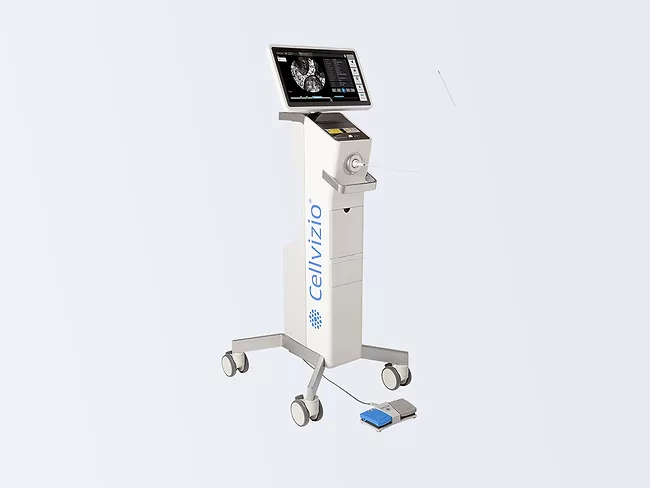
PARIS – Mauna Kea Technologies SA reported the commercial launch of a new generation of its in vivo cellular imaging for diagnostics in gastroenterology. At the same time, the company is deploying its new needle-based and miniprobe-based multidisciplinary confocal laser endomicroscopy platform in the U.S., as well as in France, Germany and Italy.
PARIS – A Russian research consortium has discovered that coating magnetic nanoparticles with a non-magnetic silica shell significantly decreased the viability of cancer cells in a low frequency alternating magnetic field. This discovery may augur new therapeutic prospects for nanotechnology combined with medical imaging.
TORONTO – Radialis Medical Inc. has submitted FDA premarket notification for a positron emission tomography system (PET) that targets specific organs for low dose imaging and may be flexible enough to assess many different diseases. The Radialis PET camera is under clinical investigation at Toronto’s University Health Network and Princess Margaret Cancer Center for its ability to assess anomalies in breast cancer.
 RSS
RSS