“In an impressive eight-month timeline,” South Korea’s Lunit Inc. completed the $193 million (AU$292 million) acquisition of Volpara Health Technologies Ltd. to globally advance artificial intelligence (AI)-based cancer care.
Shanghai- and San Diego-based Degron Therapeutics Inc. secured a potential $1.2 billion deal with Tokyo-headquartered Takeda Pharmaceutical Co. Ltd. May 23 for a multitarget collaboration and exclusive licensing agreement for molecular glue degraders. “It is a breakthrough technology in the small-molecule drug discovery field,” Degron CEO Lily Zou told BioWorld. “People talk about cell and gene therapy, but small molecules are still the mainstream of drug discovery, [with] more reach.”
Shanghai- and San Diego-based Degron Therapeutics Inc. secured a potential $1.2 billion deal with Tokyo-headquartered Takeda Pharmaceutical Co. Ltd. May 23 for a multitarget collaboration and exclusive licensing agreement for molecular glue degraders. “It is a breakthrough technology in the small-molecule drug discovery field,” Degron CEO Lily Zou told BioWorld. “People talk about cell and gene therapy, but small molecules are still the mainstream of drug discovery, [with] more reach.”
Hørsholm, Denmark-based Contera Pharma A/S’ lead asset for levodopa-induced dyskinesia in Parkinson’s disease, JM-010, failed to meet its primary endpoint in the late-stage phase IIb Astoria trial. JM-010 is a novel drug formulation and 5-HT receptor modulator that combines existing medications of immediate-release buspirone and extended-release zolmitriptan.
Shares of Redwood City, Calif.-based Rezolute Inc., and Korean parent company Handok Inc., rose May 22 on positive results of a phase II proof-of-concept study for its investigative oral diabetic macular edema (DME) drug, RZ-402. RZ-402 is an oral small-molecule plasma kallikrein inhibitor designed to block vascular leakage and inflammation for treating chronic DME.
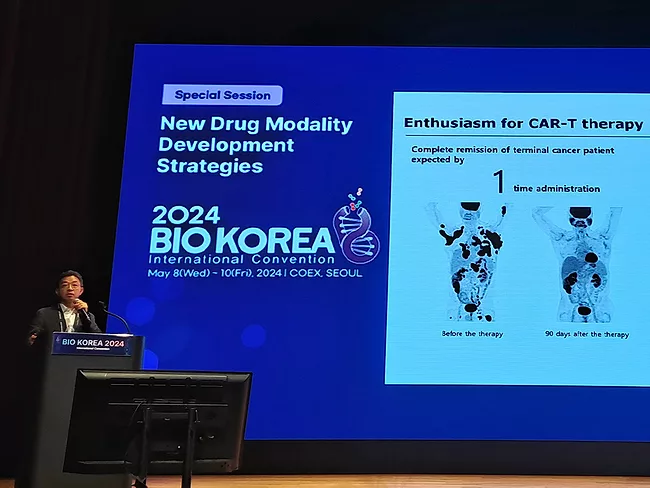
As South Korea’s Curocell Inc. looks to develop the country’s first homegrown CAR T-cell therapy, CEO Gunsoo Kim highlighted rising and falling trends in the global CAR T development space at Bio Korea 2024.
The U.S. Trade Representative (USTR) once again called out the usual cast of characters in this year’s Special 301 Report for not playing by the rules when it comes to protecting intellectual property. And once again, industry asked the USTR to go further by placing new players on the list.
Théa Open Innovation, a subsidiary of France’s Laboratoires Théa SAS, returned rights to South Korea’s Curacle Co. Ltd.’s CU-06, an oral diabetic macular edema drug candidate. Curacle posted positive top-line phase IIa data of CU-06 just three months prior.
The U.S. FDA approved the country’s first two interchangeable biosimilars, or copy products, of Regeneron Pharmaceuticals Inc./Bayer AG’s Eylea (aflibercept) on May 20, to treat four eye-related conditions. The FDA granted the approvals to U.S.- and India-based Johnson & Johnson Services Inc./Biocon Biologics Ltd.’s Yesafili (aflibercept-jbvf; M-710) and South Korea’s Samsung Bioepis Co. Ltd.’s Opuviz (aflibercept-yszy; SB-15).
Shaking up corporate and pipeline structure, San Diego-based cancer developer Erasca Inc. in-licensed two assets from China-based biopharmas in all-cash deals, while laying off 18% of its workforce, primarily in drug discovery. The flurry of announcements made on May 16, which included $160 million raised in private placement, showed that Erasca would scrap three existing pipeline assets – ERAS-007, ERAS-801 and ERAS-4 – and reshape development to a RAS-targeting franchise.
 RSS
RSS