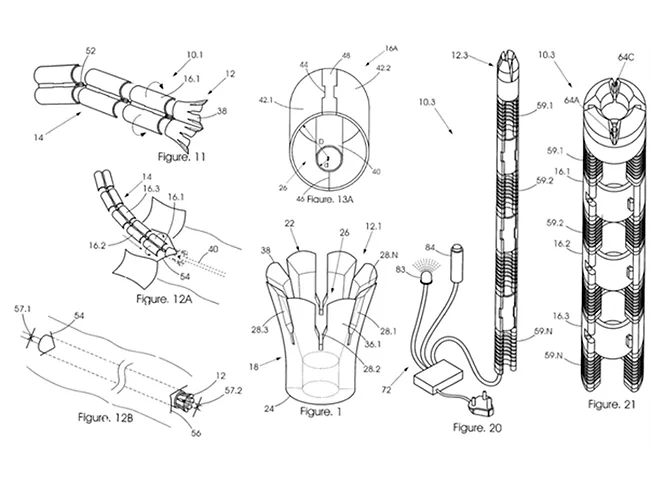
In what represents Vienna, Austria-based Valeriot GmbH’s first patenting, its founder and CEO, Michael Flatscher, describes their invention of a device, Autovein, for use in no-touch vein harvesting which overcomes the issues faced with traditional vein harvesting techniques which are laborious, prone to complications and challenging to master.
The U.S. Court of Appeals for the Federal Circuit shot down Planmeca’s argument that expert testimony provided by Osseo was disqualified because the expert was not a PHOSITA at the time the patented articles were developed, leaving Planmeca with a negative verdict in excess of $2 million.
Jiangsu Vcare Pharmatech Co. Ltd. has described proteolysis targeting chimera (PROTAC) compounds comprising an E3 ubiquitin ligase binding moiety covalently linked to a Bruton’s tyrosine kinase (BTK) targeting moiety via a linker reported to be useful for the treatment of cancer.
Nanjing Mingde New Drug Research Co. Ltd. has divulged pyrimidinone derivatives acting as P2X purinoceptor 3 (P2RX3; P2X3) antagonists reported to be useful for the treatment of cough.
Merck Sharp & Dohme LLC has identified plasma kallikrein (KLKB1) Inhibitors reported to be useful for the treatment of diabetic retinopathy, retinal vein occlusion, hereditary angioedema, diabetes, pancreatitis, intracerebral hemorrhage, nephropathy and inflammatory disorders.
Distinguishing between contract law and patent law, the U.S. Court of Appeals for the Third Circuit ruled against a Merck KGaA subsidiary, saying Ares Trading SA is still on the hook for paying royalties to a research partner through 2027 on sales of its cancer drug Bavencio (avelumab), a PD-L1 inhibitor granted accelerated approval in 2017 as a treatment for metastatic Merkel cell carcinoma.
Scientists at Helmholtz Zentrum für Infektionsforschung GmbH and Medizinische Hochschule Hannover have divulged oxadiazole derivatives reported to be useful for the treatment of cytomegalovirus infections.
 RSS
RSS