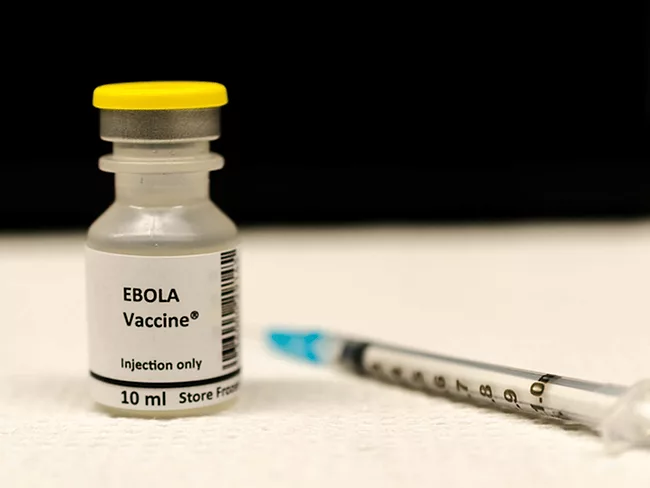
Less than two weeks after the outbreak was officially declared, animal studies of a newly designed vaccine against the Bundibugyo Ebola virus are now underway in the U.S. and U.K., and the Serum Institute of India is standing ready to manufacture the vaccine for clinical trials. If the animal tests are positive, the vaccine will be ready for clinical trials in two to three months.
Less than two weeks after the outbreak was officially declared, animal studies of a newly designed vaccine against the Bundibugyo Ebola virus are now underway in the U.S. and U.K., and the Serum Institute of India is standing ready to manufacture the vaccine for clinical trials. If the animal tests are positive, the vaccine will be ready for clinical trials in two to three months.
While Ebola virus disease in the U.S. is a rare occurrence, the FDA approval of Merck & Co. Inc.’s Ervebo, the agency’s first for preventing Ebola Zaire virus in people age 18 and older, will have a ripple effect across the world, especially Africa where its effects have been devastating for decades. Stockpiling such a vaccine is crucial to world safety as Ebola has long been a potential bioterrorism threat, especially after 9/11. In the world of theoretical biological warfare, where the virus could be weaponized and disseminated by aerosol, Ebola virus is considered the most dangerous, with fatality rates estimated between 25% to 90%.