The ongoing controversy over the effectiveness of anti-amyloid drugs is about to get more heated, after a review of clinical trials showed statistically significant results do not read across to clinical benefit for patients with Alzheimer’s disease.
The U.S. FDA needs to strengthen the guardrails along the accelerated approval pathway to ensure its “appropriate and consistent use,” the Health and Human Services Office of Inspector General (OIG) said in a report released Jan. 14.
Just as it is for terminally ill cancer patients, time is of the essence for people in the early stages of Alzheimer’s disease. Thus, the clinical meaningfulness of Eli Lilly and Co.’s donanemab is the time it gives patients before the disease progresses, Reisa Sperling, a neurology professor at Harvard Medical School and director of the Center for Alzheimer’s Research and Treatment at Brigham and Women’s Hospital, told the U.S. FDA’s Peripheral and Central Nervous System Drugs Advisory Committee June 10.
Just as it is for terminally ill cancer patients, time is of the essence for people in the early stages of Alzheimer’s disease. Thus, the clinical meaningfulness of Eli Lilly and Co.’s donanemab is the time it gives patients before the disease progresses, Reisa Sperling, a neurology professor at Harvard Medical School and director of the Center for Alzheimer’s Research and Treatment at Brigham and Women’s Hospital, told the U.S. FDA’s Peripheral and Central Nervous System Drugs Advisory Committee June 10.
At first glance, the number of drugs that received accelerated approval from the U.S. FDA’s Center for Drug Evaluation and Research (CDER) in 2023 was nothing to write home about. Yes, CDER granted nine accelerated approvals last year, up from six in 2022. But the proportion of novel drugs with accelerated approval was 16% both years. And when compared with the 12 drugs in 2020 and the 14 that received accelerated approval in 2021, last year’s crop was a little lackluster. However, a deeper look at the 2023 class of accelerated approvals shows a historic milestone. For the first time since the path was created in 1992, the number of novel biologics getting accelerated approval at CDER outpaced the number of small-molecule drugs.
Reflecting the evolving scientific understanding of Alzheimer’s disease, the U.S. FDA revised its 2018 draft guidance on developing drugs to treat early Alzheimer’s.
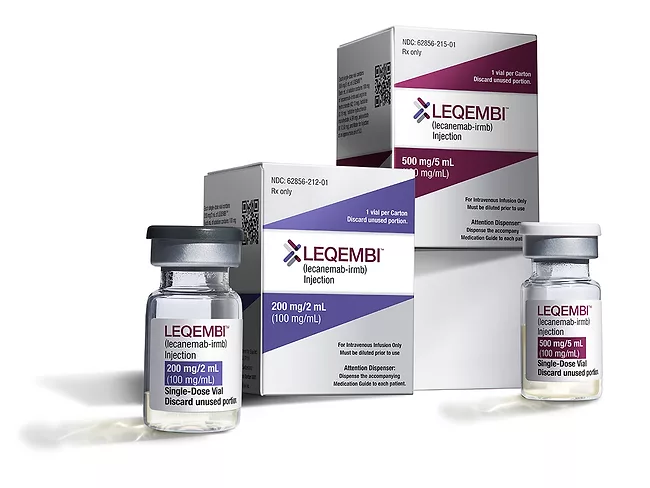
Biogen Inc.’s problematic trip with Aduhelm (aducanumab-avwa) for Alzheimer’s disease (AD) at last came to an end as the company, probably surprising few on Wall Street, said it’s quitting sales and development of the amyloid-beta directed antibody. The drug won accelerated approval by the U.S. FDA in July 2021. The phase III Envision study with Aduhelm will be stopped, and Cambridge, Mass.-based Biogen chalked a one-time charge of about $60 million related to close-out costs for the program in the fourth quarter of 2023. AD efforts have turned toward Leqembi (lecanemab-irmb), also an amyloid-beta directed antibody.
In July, Leqembi (lecanemab, Biogen Inc./Eisai Co. Ltd.) became the first amyloid-targeting drug to win traditional approval from the U.S. FDA, after getting accelerated approval in January based on the surrogate endpoint of plaque removal.
With the approval of Aduhelm (aducanumab, Eli Lilly & Co.) and Leqembi (lecanemab, Eisai Co. Ltd.), there are finally amyloid-targeting drugs available for Alzheimer’s disease (AD). What’s not available, though, are rose-colored glasses of the prescription strength that would make these approvals look like AD’s happy ending. The biopharma industry is already well aware of the need for broader horizons. Roughly three-quarters of drugs now in clinical development for AD target neither amyloid-β (Aβ) nor tau. Still, the genetic evidence from familial AD strongly implicates Aβ processing in AD’s origins. In his opening plenary talk at the European Academy of Neurology 2023 annual conference, Thomas Südhof suggested new ways to look at the clinical data.
U.S. Centers for Medicare & Medicaid Services (CMS) Administrator Chiquita Brooks-LaSure made her first appearance April 26 before the House Energy and Commerce’s Subcommittee on Health, ostensibly to discuss legislative solutions to increase transparency and competition in health care. But member after member, regardless of political party, demanded answers about why CMS continues to severely restrict access to Eisai Co. Ltd.’s Alzheimer’s drug, Leqembi (lecanemab), especially since another government agency is covering it for all veterans that meet the labeling requirements.