In efforts to strengthen cooperation between the U.S. and South Korea’s life sciences sector, industry organizations like Biocom California and KoreaBIO are helping foster cross-border collaboration as Korea looks to ramp up the so-called Bio Economy 2.0. KoreaBIO, which stands for the Korea Biotechnology Industry Organization, in its latest feat welcomed a trade delegation run by the San Diego Regional Economic Development Corp. and the World Trade Center San Diego in November 2023, helping bolster cooperation between companies in Korea and in the San Diego and Tijuana, Mexico, regions.
In efforts to strengthen cooperation between the U.S. and South Korea’s life sciences sector, industry organizations like Biocom California and KoreaBIO are helping foster cross-border collaboration as Korea looks to ramp up the so-called Bio Economy 2.0. KoreaBIO, which stands for the Korea Biotechnology Industry Organization, in its latest feat welcomed a trade delegation run by the San Diego Regional Economic Development Corp. and the World Trade Center San Diego in November 2023, helping bolster cooperation between companies in Korea and in the San Diego and Tijuana, Mexico, regions.
South Korean researchers from the Gwangju Institute of Science and Technology (GIST) have penned a “groundbreaking” adversarial task adaptive pretraining (A-TAPT) model that could improve the accuracy of analyzing vocal cord vibrations for medical conditions.
Medical Microinstruments Inc. (MMI) is expanding its Symani surgical system into the Asia Pacific – a region with “clear demand for the technology” – through two local partners, Device Technologies Australia Pty Ltd. and Seoul-based TRM Korea Corp.
“Digital therapeutics (DTx) for obesity may seem light years away,” Rhee Sang-youl, of Kyung Hee University Medical Center (KHMC), said to the Korea Society of Cardiology (KSC) 2023 audience members on October 13, “but the reality is that it’s right in front of us.”
As South Korea increases its stakes on the “bioeconomy” as its next growth engine and as its “second semiconductor industry,” leading domestic biologic and biosimilar drug producers such as Samsung Biologics Co. Ltd. and Celltrion Inc. are setting record production targets to become forerunners in the global playing field.
National support for the biosimilar sector and the domestic industry’s efforts to increase production and sales may not be enough for South Korean biosimilar firms to box out competition in the ever-changing regulatory court of the U.S.
National support for the biosimilar sector and the domestic industry’s efforts to increase production and sales may not be enough for South Korean biosimilar firms to box out competition in the ever-changing regulatory court of the U.S. “Competition in U.S. negotiations and rebates are fierce,” Choi Sung-ho, chairman of the Korean Society for Bioeconomy, said. “Even if you get listed, it is crucial to be placed in an advantageous class to lower out-of-pocket costs.
As South Korea increases its stakes on the “bioeconomy” as its next growth engine and as its “second semiconductor industry,” leading domestic biologic and biosimilar drug producers such as Samsung Biologics Co. Ltd. and Celltrion Inc. are setting record production targets to become forerunners in the global playing field.
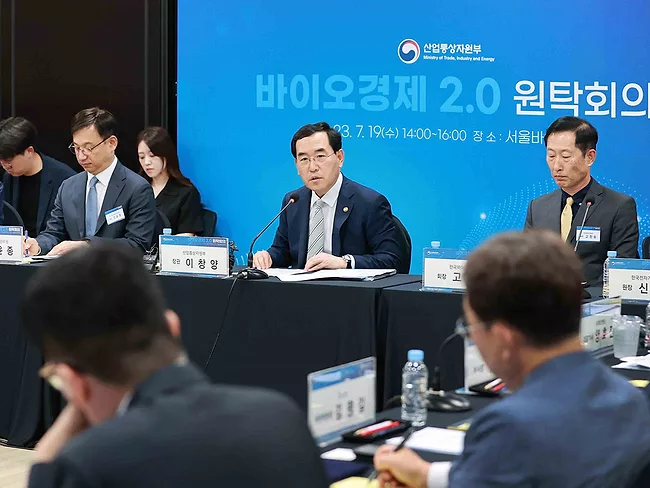
In July 2023, South Korea’s Ministry of Trade, Industry and Energy ramped up efforts to kickstart the so-called “Bio Economy 2.0,” the newfound initiative that banks on the biopharmaceutical industry to potentially revitalize the country’s slowing economic and social growth. Highlighting four major areas – biopharmaceuticals, biomaterials, bioenergy and digital technologies – as the four “wheels” to carry the biopharma industry, the new plan underscored the government’s unwavering support for the sector while highlighting its vision to become the “number one bioeconomy” worldwide.