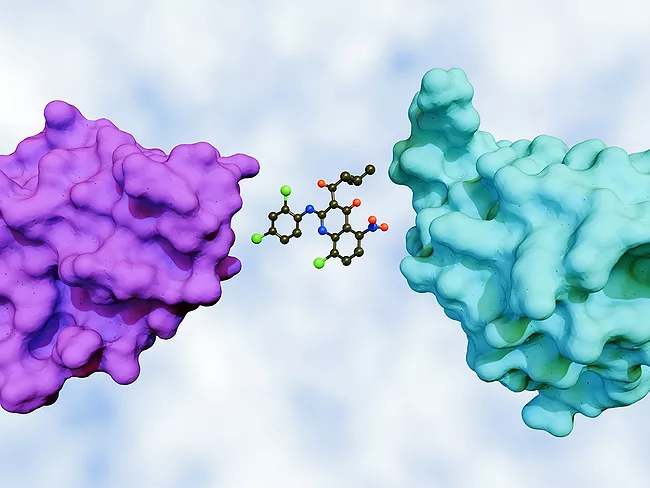
Degradation is a therapeutic strategy that could offer possibilities to get at currently undruggable target proteins. In targeted degradation, compounds induce interactions between a target protein and a protein that can tag the target for degradation. In principle, there are several pathways that could be used for such tagging; the most attention has gone to ubiquitin ligases, in particular cereblon, a protein that is part of a ubiquitin ligase complex and the target of several approved drugs.
Degradation is a therapeutic strategy that could offer possibilities to get at currently undruggable target proteins. In targeted degradation, compounds induce interactions between a target protein and a protein that can tag the target for degradation. In principle, there are several pathways that could be used for such tagging; the most attention has gone to ubiquitin ligases, in particular cereblon, a protein that is part of a ubiquitin ligase complex and the target of several approved drugs.
Degradation is a therapeutic strategy that could offer possibilities to get at currently undruggable target proteins. In targeted degradation, compounds induce interactions between a target protein and a protein that can tag the target for degradation. In principle, there are several pathways that could be used for such tagging; the most attention has gone to ubiquitin ligases, in particular cereblon, a protein that is part of a ubiquitin ligase complex and the target of several approved drugs.
VAV1 is a guanine nucleotide exchange factor essential for T- and B-cell receptor signaling, with expression largely restricted to immune cells. Loss of VAV1, via CRISPR or genetic deletion, impairs effector functions in both T and B cells.
Kymera Therapeutics Inc. found itself juggling partnerships by bringing one on board while going to the development bench in another. Kymera and Gilead Sciences Inc. will collaborate on a molecular glue degrader program that targets cyclin-dependent kinase 2 in solid tumors, including breast cancer.
Monte Rosa Therapeutics Inc. has gained IND clearance from the FDA for MRT-8102, a NEK7-directed molecular glue degrader being developed to treat inflammatory conditions linked to NLRP3, IL-1β and IL-6 dysregulation.
Monte Rosa Therapeutics Inc. has divulged molecular glues as cyclin-dependent kinase 2 (CDK2) degradation inducers reported to be useful for the treatment of cancer and amyloidosis.
An old target that found new life at Monte Rosa Therapeutics Inc. has become the subject of a sizeable deal between the company and Novartis AG, as the pair set about developing molecular glue degraders (MGDs). Shares of Monte Rosa (NASDAQ:GLUE) closed Oct. 28 at $9.48, up $4.59, or 93.9%, on word of the Boston-based firm’s deal with Novartis to advance VAV1 MGDs, including MRT-6160, a prospect undergoing a phase I single ascending dose/multiple ascending dose study in healthy volunteers for immune-mediated conditions.
Monte Rosa Therapeutics Inc. has submitted an IND application to the FDA for MRT-6160, a highly selective and orally bioavailable molecular glue degrader directed against VAV1 in development for systemic and neurological autoimmune diseases.
The immune cell restricted guanine nucleotide exchange factor (GEF) and scaffolding protein VAV1 plays a key role in mediating T-cell receptor (TCR) and B-cell receptor (BCR) activity and signaling.