As it continues its crackdown on accelerated approval, the FDA continues to stress that successfully completing confirmatory trials should be the top priority for sponsors of drugs that enter the U.S. market via accelerated approval.
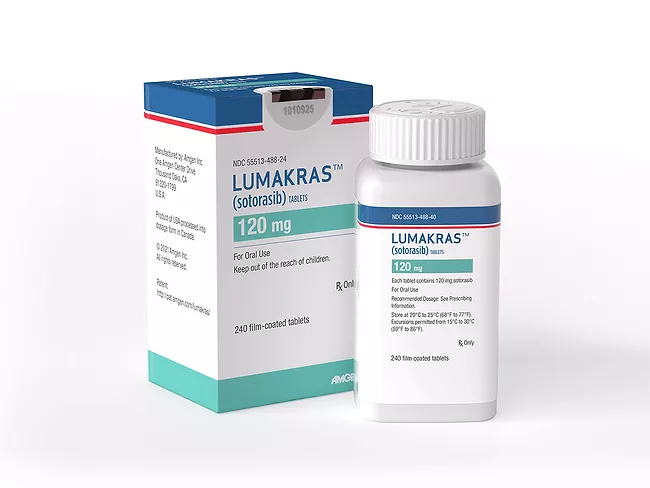
The dark cloud of what the U.S. FDA called potential “systemic bias” rained on Amgen Inc.’s bid for full approval of Lumakras (sotorasib), a KRAS-G12C inhibitor that was granted accelerated approval in May 2021 for locally advanced or metastatic non-small-cell lung cancer after at least one systemic therapy.
Bad news for Amgen Inc. could mean upside for Mirati Therapeutics Inc., though the meeting of the U.S. FDA’s Oncologic Drugs Advisory Committee (ODAC) has yet to tell the tale regarding Lumakras (sotorasib), the former’s KRAS-G12C inhibitor.
After considering the evidence, the U.S. FDA’s Oncologic Drugs Advisory Committee (ODAC) voted 14-6 Oct. 4 that the data from a single external-controlled trial and well-established preclinical animal models present sufficient evidence to demonstrate that US Worldmeds LLC’s DFMO (eflornithine) improves event-free survival in pediatric patients with high-risk neuroblastoma.
For the second time in two weeks, the extent of regulatory flexibility will be at the heart of a U.S. FDA advisory committee meeting. The Oct. 4 meeting of the Oncologic Drugs Advisory Committee (ODAC) comes exactly a week after the Cellular, Tissue and Gene Therapies Advisory Committee voted overwhelmingly that the evidence presented for Brainstorm Cell Therapeutics Inc.’s amyotrophic lateral sclerosis drug, Nurown (debamestrocel), didn’t meet the agency’s flexibility standard. If the FDA’s briefing document for the ODAC meeting is anything to go by, the outcome for US Worldmeds LLC’s eflornithine, also known as DFMO, could be more positive, even though once again the agency is asking if the evidence from a single trial, along with supportive data, is sufficient.
Brainstorm Cell Therapeutics Inc. said it’s exploring all its options in the wake of a Sept. 27 U.S. FDA advisory committee vote, in which the committee overwhelmingly disagreed with the company that the data it presented supported the effectiveness of Nurown (debamestrocel) for the treatment of mild to moderate amyotrophic lateral sclerosis.
Brainstorm Cell Therapeutics Inc.’s Nurown got a thumbs down from the U.S. FDA’s Cellular, Tissue and Gene Therapies Advisory Committee Sept. 27, as the committee voted 1-17, with one abstention, that the data presented demonstrated substantial evidence of effectiveness for treatment of mild to moderate amyotrophic lateral sclerosis.
How flexible should the U.S. FDA evidentiary standards be for a therapy addressing a significant unmet need in a disease such as amyotrophic lateral sclerosis (ALS)? That’s the question the agency’s Cellular, Tissue and Gene Therapies Advisory Committee will ponder Sept. 27 as it looks at the data for Brainstorm Cell Therapuetics Inc.’s Nurown (debamestrocel), a mesenchymal stromal cell therapy targeting ALS. Nurown is going into the adcom with a bit of a checkered history that includes a refuse-to-file letter and a single phase III trial that failed to demonstrate efficacy for the primary endpoint and all key secondary efficacy endpoints, according to the FDA briefing document.
Safety concerns overrode benefit when the U.S. FDA’s Endocrinologic and Metabolic Drugs Advisory Committee (EMDAC) voted unanimously, 19-0, Sept. 21 that the potential risks of Intarcia Therapeutics’ ITCA-650 outweighed the compliance and A1C-lowering benefits the twice-yearly implantable exenatide-device combination product could provide for adults with type 2 diabetes.
A Sept. 21 U.S. FDA advisory committee meeting will either be a “Hail Mary” or a last gasp of life for ITCA-650, a twice-yearly implantable exenatide-device combination product intended to improve glycemic control in adults with type 2 diabetes.