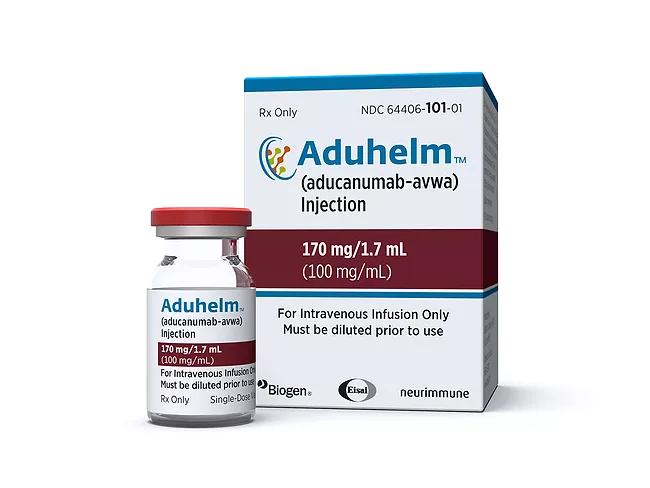
The FDA’s recent release of documents related to its accelerated approval of Aduhelm (aducanumab) did little to reduce the controversy surrounding that decision and the U.S. pricing of Biogen Inc.’s Alzheimer’s drug.
New FDA breakthrough therapy designations awarded for two investigational Alzheimer's disease (AD) candidates, Eli Lilly and Co.'s donanemab and the Bioarctic AB-Eisai Co. Ltd.-developed asset lecanemab (BAN-2401) underline ongoing willingness at the U.S. regulator to invest deeper attention in the potential of amyloid plaque reduction to slow progress of the disease, a critical and costly challenge estimated to affect more than 6 million Americans.
More than two weeks after the FDA gave its go-ahead to Biogen Inc.’s Aduhelm (aducanumab), controversy still rages over the accelerated approval as well as the price for the anti-amyloid beta monoclonal antibody for Alzheimer’s disease (AD). Embattled U.S. regulators made the uncommon move of releasing documents – with more due to be made public later – that show the internal deliberations that led to Aduhelm’s clearance.
Biogen Inc.’s $56,000-a-year list price for its newly approved Alzheimer’s drug, Aduhelm (aducanumab), is sending tremors through the prescription drug pricing debate that could shift the epicenter of those discussions to drugs granted accelerated approval based on surrogate endpoints.
PERTH, Australia – Digital cognitive assessment technology company Cogstate Ltd. saw its stock skyrocket 60% on the heels of FDA accelerated approval of Biogen Inc./Eisai Co. Ltd.’s Alzheimer’s disease drug Aduhelm (aducanumab). Cogstate and Eisai signed a deal in October 2020 that granted Eisai global development rights and exclusive commercialization rights of all cognitive function tests developed by Cogstate.
As debate continues to rage over the approval and pricing of the Alzheimer’s disease therapy Aduhelm (aducanumab), Biogen Inc. CEO Michel Vounatsos said his firm is “taking a position that is very responsible” but has “yet to be understood out there, and we have to do a better job.”
LONDON – Controversy over the quality of the data supporting approval of Biogen Inc.’s Aduhelm (aducanumab), and FDA’s requirement for a phase IV study to demonstrate real-world evidence of the effectiveness of the drug, has put the spotlight on the need for better dementia diagnostics, both to stratify trials and to track any reduction in clinical decline.
Biogen Inc.’s pricing of its newly approved Alzheimer’s drug, Aduhelm (aducanumab), has made it the latest bull’s eye for lawmakers and advocacy groups targeting U.S. drug prices, especially given the controversy surrounding the drug’s approval, which has resulted in the resignation of three of the 11 members of the FDA’s Peripheral and Central Nervous System Drugs Advisory Committee.
Of all the controversies surrounding the FDA, the agency’s reliance on user fees and its use of accelerated review of therapies might be the most consistent sources of public angst. Coleen Klasmeier, a partner of Sidley Austin LLP, told BioWorld that while she is not particularly concerned about regulatory capture stemming from FDA reliance on user fees, it may be appropriate to ask whether the drug premarket review process leaves FDA staff with more confidence in a new drug application than the data would seem to suggest.
Developers of blood tests for the early diagnosis of Alzheimer’s disease (AD) are poised to see a spike in demand, following the FDA’s accelerated approval on Tuesday of Cambridge, Mass.-based Biogen Inc.’s AD drug treatment Aduhelm (aducanumab). The FDA’s decision paves the way for AD assays to move beyond aiding in drug development toward addressing ongoing issues with undiagnosed cases.