The U.S. Veterans Health Administration (VA) is being applauded for doing what Medicare has refused to do – provide coverage for Leqembi (lecanemab) in the early stages of Alzheimer’s disease. Under the March 13 VA decision, the Eisai Co. Ltd. drug, which was partnered with Biogen Inc. and granted accelerated approval in January, will be listed as a nonformulary therapy that must be prescribed by a VA-board certified neurologist, geriatric psychiatrist or geriatrician who specializes in treating dementia.
Now that the U.S. FDA has granted accelerated approval for Biogen Inc./Eisai Co. Ltd.’s early Alzheimer’s drug, Leqembi (lecanemab), the Centers for Medicare & Medicaid Services (CMS) is being pressured to rethink its coverage of amyloid-targeting monoclonal antibodies.
In the wake of ongoing criticism over the U.S. FDA’s 2021 accelerated approval of Biogen Inc.’s Alzheimer’s drug, Aduhelm, the percentage of novel drugs receiving accelerated approval last year was the lowest it’s been since 2018.
Citing an "atypical FDA review process and corporate greed" ahead of the controversial approval of Biogen Inc.'s Aduhelm (aducanumab), Energy and Commerce Committee Chairman Frank Pallone (D-N.J.) called for "corrective actions" at the agency to "re-earn the trust of the American people." Pallone's comments prefaced a report drawn from 18 months of investigation around the regulatory review and approval process for the Alzheimer's disease drug, as well as Biogen’s pricing strategy.
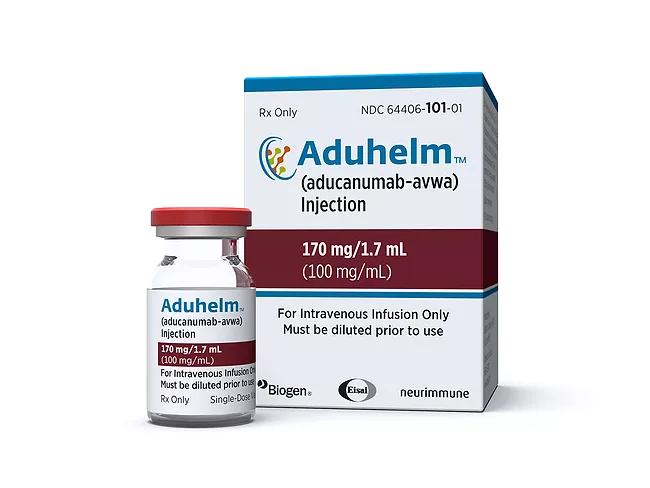
In 2021, Biogen Inc.’s Aduhelm (aducanumab) became the first amyloid-targeting therapy to win U.S. FDA approval in Alzheimer’s disease. After decades and dozens of failed phase III trials, the drug was granted accelerated approval in June 2021. In January 2022, however, the U.S. Center for Medicare & Medicaid Services said it would only cover use of Alzheimer’s MAbs targeting amyloid in NIH trials or trials it approved, thus appearing to call into question the rigor of FDA-approved trials.
The shadow of two reported patients’ deaths hovers over Eisai Co Ltd. and Biogen Inc.’s Alzheimer’s disease treatment, lecanemab, as the companies prepare to present phase III study data on the drug later today at the 15th Clinical Trials on Alzheimer's Disease conference.
Researchers at the University of Cincinnati have published data showing that in patients with dominantly inherited Alzheimer’s disease-causing mutations, high levels of soluble amyloid-β42 (Aβ42) in the cerebrospinal fluid predicted a reduced risk of developing dementia over three years.
Researchers at the University of Cincinnati have published data showing that in patients with dominantly inherited Alzheimer’s disease (AD)-causing mutations, high levels of soluble amyloid-β42 (Aβ42) in the cerebrospinal fluid (CSF) predicted a reduced risk of developing dementia over 3 years. Their work, which appeared in the Oct. 4, 2022, print issue of the Journal of Alzheimer’s Disease after earlier publication online, suggests that the problem with amyloid in AD may be a lack of soluble amyloid-β, rather than a surfeit of plaques.
The U.S. Centers for Medicare & Medicaid Services is finally making a long-expected, and requested, adjustment to Medicare Part B premiums, which were raised nearly 15% for 2022 in the wake of Biogen Inc.’s initial $56,000 annual price tag for its Alzheimer’s drug, Aduhelm (aducanumab).
The U.S. FDA’s accelerated approval path is front burner these days, what with Congress looking to modernize the path through provisions added to the must-pass user fee legislation, the controversy still boiling over the FDA’s accelerated approval last year of Biogen Inc.’s Alzheimer’s drug, Aduhelm (aducanumab), and a number of recent withdrawals of drugs granted accelerated approval years ago.