Pivotal in killing the Biden administration’s Build Back Better budget legislation, Sen. Joe Manchin (D-W.Va.) is now working to revive parts of it, including the provision that would require Medicare to directly negotiate prescription drug prices.
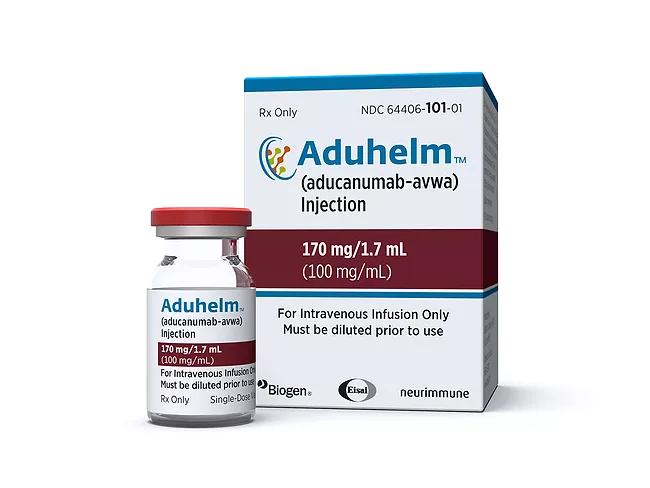
The flop that is Aduhelm (aducanumab) made itself felt in Biogen Inc.’s executive suite as CEO Michael Vounatsos is leaving the company. He had the job for five and a half years and for less than a year after the controversial Alzheimer’s treatment was approved. He will stick around until a successor is found.
The U.S. Centers for Medicare & Medicaid Services’ (CMS) decision last month restricting coverage of a class of Alzheimer’s drugs to clinical trials meeting the agency’s standards still isn’t sitting well with some lawmakers.
Making his first in-person appearance April 27 before the House Energy and Commerce Subcommittee on Health, U.S. Health and Human Services Secretary Xavier Becerra was prepared to answer questions about President Joe Biden’s fiscal 2023 budget that would increase HHS’ discretionary budget to $127 billion, nearly a 27% increase over the 2021 enacted level.
Biogen Inc. has given up on its attempt to get its Alzheimer’s disease drug Aduhelm (aducanumab) approved by regulators in Europe, deciding to withdraw its filing midway through a review of a previous rejection. The company had asked the European Medicines Agency’s CHMP to reconsider its negative opinion for Aduhelm in December 2021. But its subsidiary in the Netherlands wrote to the EMA this week saying that it had decided to withdraw its marketing authorization application after all.
The release by the U.S. CMS of the final national coverage determination (NCD) for Biogen Inc.’s Alzheimer disease (AD) drug, Aduhelm (aducanumab), lit speculation on the meaning for others in the space. CMS is “still being conservative,” said Howard Fillit, co-founder and chief science officer of the Alzheimer’s Drug Discovery Foundation (ADDF). “We’re in a new era. It’s unprecedented that Medicare doesn’t pay for a drug that received approval from the FDA,” even though it was not a full but an accelerated clearance.
The potholes in the U.S. FDA’s accelerated approval path could be paved over by a bill introduced in Congress this week. Rep. Frank Pallone (D-N.J.), chair of the House Energy and Commerce Committee, introduced the Accelerated Approval Integrity Act March 8 to keep the path open to innovative drugs where there is unmet need while streamlining the process for taking drugs off the market when they don’t prove clinical benefit in a timely manner.
The process of reauthorizing critical U.S. FDA user fee agreements (UFAs) for drugs, generics and biosimilars took its first step forward in Congress Feb. 3 as the House Energy & Commerce Subcommittee on Health dipped its feet into the new enhancements included in the agreements the FDA negotiated with stakeholders over the past two years.
The U.S. Center for Medicare & Medicaid Services (CMS) opened a 30-day comment window on its proposed national coverage determination (NCD) to limit Medicare access to monoclonal antibodies targeting amyloid beta in Alzheimer’s disease (AD) only in clinical trials. Biogen Inc., clearly the target, along with its AD treatment Aduhelm (aducanumab), was among the first to respond.
In proposing a national coverage determination to limit coverage of a class of Alzheimer’s drugs to those being used in clinical trials approved by the U.S. Center for Medicare & Medicaid Services or the NIH, CMS appears to be treading in FDA territory. “For the first time ever, Medicare is second-guessing FDA – and not only on work that it has already done, but on work FDA will do in the future,” said George Vradenburg, chair and co-founder of Us Against Alzheimer’s, a patient advocacy group. “HHS [the Department of Health and Human Services] is clearly at war with itself, with one agency approving this class of drugs and another slamming the door shut on treatment. . .. Does CMS no longer trust the FDA’s work?”