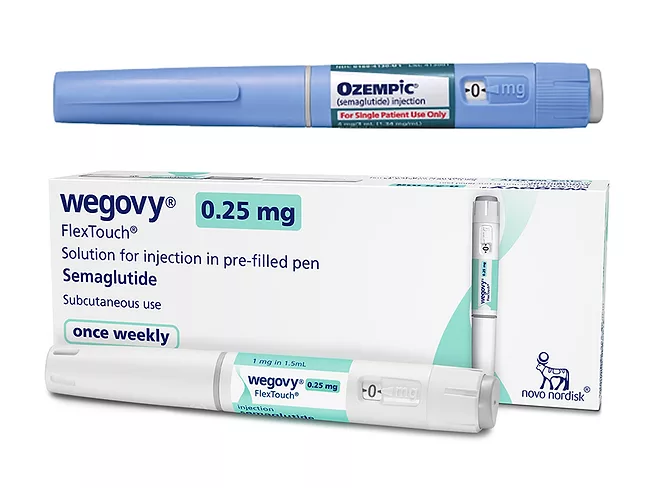
The obesity market is hot with Novo Nordisk A/S generating $6.3 billion in sales from its semaglutide-containing drugs, Ozempic, Saxenda, Rybelsus and Wegovy, in the first quarter of 2024 and Eli Lilly and Co. bringing in $2.3 billion for its tirzepatide-containing drugs, Zepbound and Mounjaro, in the same quarter. It appears unlikely the market will be a two-horse race for much longer though.
In the wake of Novo Nordisk’s semaglutide nabbing the title of the U.S.’s biggest blockbuster drug, it’s little surprise that Amgen Inc.’s obesity candidate, Maritide (maridebart cafraglutide), hogged the stage during the firm’s first-quarter earnings call after market close May 2, with company executives touting promising phase II data and a differentiated profile, sending shares of Thousand Oaks, Calif.-based Amgen (NASDAQ:AMGN) up nearly 12% to close May 3 at $311.29.
There was a time not that long ago when Merck & Co. Inc.’s Keytruda (pembrolizumab), with its multiple cancer indications, was seen as the heir apparent to Humira’s title of the biggest blockbuster drug. Not anymore. That title now belongs to Novo Nordisk A/S’ semaglutide, approved as Ozempic in 2017 to treat diabetes and as Wegovy in 2021 to help with weight loss.
Eli Lilly and Co. is planning to file for U.S. FDA approval later this year after reporting that tirzepatide met all primary and key secondary endpoints in two phase III trials in obstructive sleep apnea (OSA). Assuming approval, tirzepatide could become the first drug approved specifically for OSA, while providing potential entry access for Medicare Part D coverage, which is denied for the GLP-1 class of drugs approved as obesity medications.
Eli Lilly and Co. continues its development of an oral drug delivery device that can successfully deliver a drug that would otherwise be ineffective when taken orally.
The demand for semaglutide, a GLP-1 drug, and other popular prescription weight-loss drugs is adding to the U.S. FDA’s regulatory load as more and more companies are offering unapproved knockoffs of the products directly to consumers. The FDA posted two warning letters Feb. 13 – to Miami-based US Chem Labs and a New-York company, Synthetix Inc. doing business as Helix Chemical Supply – citing the companies for misbranding unapproved semaglutide and tirzepatide, also a GLP-1 drug, by marketing them on the Internet, along with claims about their therapeutic benefits.
Bioage Labs Inc.’s $170 million series D financing will pay for phase II trials with azelaprag, an apelin receptor agonist, to be tried in combination with Zepbound (tirzepatide), the glucose-dependent insulinotropic polypeptide receptor and glucagon-like peptide-1 (GLP-1) receptor agonist from Bioage partner Eli Lilly and Co.
If there is one therapeutic area for which numerous biopharma companies and investors have shown increasing amounts of interest in 2023, it is obesity through follow-on glucagon-like peptide-1 receptor agonists, as well as combination and solo efforts with other potential mechanisms. Analysts have suggested the obesity market (which includes overweight individuals) could grow to more than $50 billion by 2030. At least.
Astrazeneca plc will pay up to $2 billion for Eccogene Co. Ltd.’s oral weight loss candidate, ECC-5004, as big and small pharma players alike work to gain ground in the burgeoning obesity market where Eli Lilly and Co. scored the latest U.S. FDA approval of Zepbound (tirzepatide).
Astrazeneca plc will pay up to $2 billion for Eccogene Co. Ltd.’s oral weight loss candidate, ECC-5004, as big and small pharma players alike work to gain ground in the burgeoning obesity market where Eli Lilly and Co. scored the latest U.S. FDA approval of Zepbound (tirzepatide).