At first glance, the number of drugs that received accelerated approval from the U.S. FDA’s Center for Drug Evaluation and Research (CDER) in 2023 was nothing to write home about. Yes, CDER granted nine accelerated approvals last year, up from six in 2022. But the proportion of novel drugs with accelerated approval was 16% both years. And when compared with the 12 drugs in 2020 and the 14 that received accelerated approval in 2021, last year’s crop was a little lackluster. However, a deeper look at the 2023 class of accelerated approvals shows a historic milestone. For the first time since the path was created in 1992, the number of novel biologics getting accelerated approval at CDER outpaced the number of small-molecule drugs.
Reflecting the evolving scientific understanding of Alzheimer’s disease, the U.S. FDA revised its 2018 draft guidance on developing drugs to treat early Alzheimer’s.
A first-quarter 2024 launch for Alzheimer’s drug donanemab appears to be off the table as Eli Lilly and Co. disclosed a last-minute decision by the U.S. FDA to convene an advisory committee to review data from the phase III Trailblazer-ALZ 2 trial.
Biogen Inc.’s problematic trip with Aduhelm (aducanumab-avwa) for Alzheimer’s disease (AD) at last came to an end as the company, probably surprising few on Wall Street, said it’s quitting sales and development of the amyloid-beta directed antibody. The drug won accelerated approval by the U.S. FDA in July 2021. The phase III Envision study with Aduhelm will be stopped, and Cambridge, Mass.-based Biogen chalked a one-time charge of about $60 million related to close-out costs for the program in the fourth quarter of 2023. AD efforts have turned toward Leqembi (lecanemab-irmb), also an amyloid-beta directed antibody.
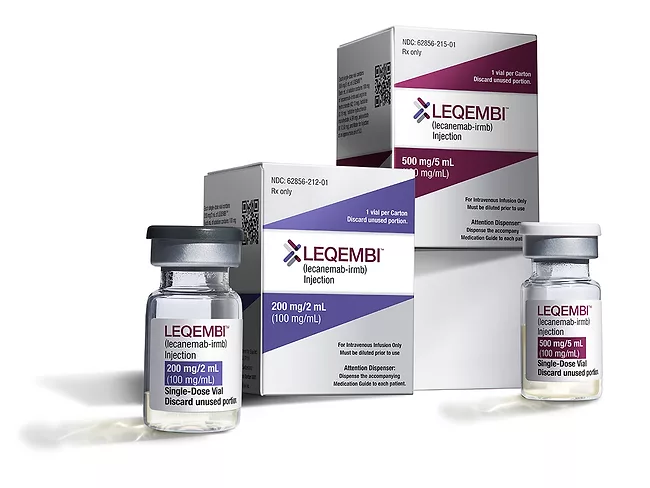
In July, Leqembi (lecanemab, Biogen Inc./Eisai Co. Ltd.) became the first amyloid-targeting drug to win traditional approval from the U.S. FDA, after getting accelerated approval in January based on the surrogate endpoint of plaque removal.
Neurophet Inc. pulled in ₩20 billion (US$15.1 million) in its series C funding round, helping roll out its AI-software suite for neurodegenerative diseases worldwide and prep its IPO on the Kosdaq which is scheduled to take place sometime in 2024.
As pricing negotiations for Biogen Inc./Eisai Co. Ltd.’s newly approved Leqembi (lecanemab) for Alzheimer’s disease get underway at Japan’s Central Social Insurance Medical Council (Chuikyo), industry watchers see opportunity for potential drug price reform.
Thanks to a raft of new approvals by Japan’s Ministry of Health, Labor and Welfare (MHLW), patients in Japan will soon have access to Biogen Inc./Eisai Co. Ltd.’s Leqembi (lecanemab), an amyloid-beta binder, for slowing progression of mild cognitive impairment and mild dementia due to Alzheimer's disease.
With the launch of intravenous Leqembi (lecanemab-irmb) for Alzheimer’s disease (AD) underway, Priya Singhal, Biogen Inc.’s head of development and interim head of research, said the firm, along with partner Eisai Co. Ltd., aims to “address the long-term duration question” with a subcutaneous version, recently touted at the Alzheimer's Association International Conference.
Questionable efficacy, high priced and risky side effects are some words to describe Leqembi (lecanemab), the latest amyloid beta-targeting antibody approved by the U.S. FDA, Korean experts said, but none of that diminishes the profound significance of the drug for Alzheimer’s disease.