Responding to medical advances and new standards of care in Alzheimer’s, the U.S. Centers for Medicare & Medicaid Services (CMS) is proposing to end its 10-year-old coverage with evidence development policy that has limited Medicare reimbursement of amyloid PET scans to once in a lifetime for beneficiaries – and then only when they’re used in a CMS-approved trial.
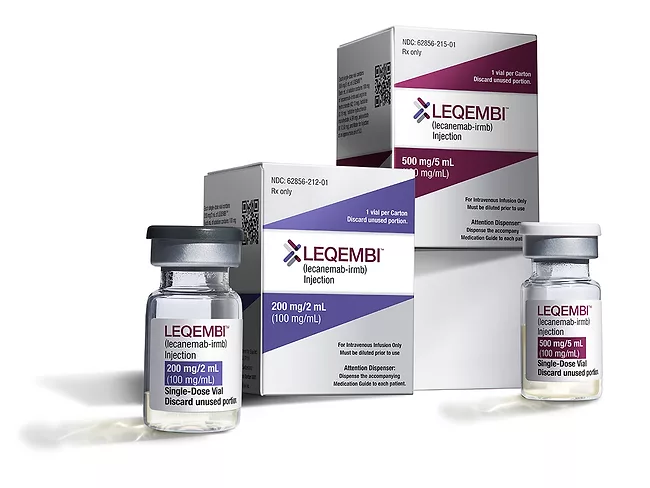
Questionable efficacy, high priced and risky side effects are some words to describe Leqembi (lecanemab), the latest amyloid beta-targeting antibody approved by the U.S. FDA, Korean experts said, but none of that diminishes the profound significance of the drug for Alzheimer’s disease.
The black box warning appended to the label of Alzheimer’s disease (AD) drug Leqembi (lecanemab) took some on Wall Street mildly aback but failed to surprise others, as analysts mulled what the full approval, granted July 6 by the U.S. FDA, might mean for other developers in the space.
The black box warning appended to the label of Alzheimer’s disease (AD) drug Leqembi (lecanemab) took some on Wall Street mildly aback but failed to surprise others, as analysts mulled what the full approval, granted July 6 by the U.S. FDA, might mean for other developers in the space.
With the approval of Aduhelm (aducanumab, Eli Lilly & Co.) and Leqembi (lecanemab, Eisai Co. Ltd.), there are finally amyloid-targeting drugs available for Alzheimer’s disease (AD). What’s not available, though, are rose-colored glasses of the prescription strength that would make these approvals look like AD’s happy ending. The biopharma industry is already well aware of the need for broader horizons. Roughly three-quarters of drugs now in clinical development for AD target neither amyloid-β (Aβ) nor tau. Still, the genetic evidence from familial AD strongly implicates Aβ processing in AD’s origins. In his opening plenary talk at the European Academy of Neurology 2023 annual conference, Thomas Südhof suggested new ways to look at the clinical data.
Eisai Co. Ltd. and Biogen Inc.’s Leqembi (lecanemab) gained the support of the U.S. FDA’s Peripheral and Central Nervous System Drugs Advisory Committee (adcom) in a 6-0 vote on June 9, as panel members unanimously agreed that the results of the phase III Clarity trial verified the clinical benefit in the treatment of Alzheimer’s disease. The FDA does not have to follow the adcom’s recommendation, but it often does. The PDUFA date for the supplemental NDA is July 6.
Six months after getting accelerated approval from the U.S. FDA without any input from an advisory committee, Eisai Co. Inc. and Biogen Inc.’s Alzheimer’s disease (AD) therapy, Leqembi (lecanemab) will make an appearance June 9 before the Peripheral and Central Nervous System Drugs Advisory Committee (PCNSDAC), set to discuss the supplemental BLA seeking to convert use of the amyloid beta-targeting antibody to traditional approval.
As the clock ticks toward the “full,” or traditional, approval date for Biogen Inc./Eisai Co. Inc.’s Alzheimer’s drug, Leqembi (lecanemab), the U.S. Centers for Medicare & Medicaid Services (CMS) is facing increasing pressure to get the structures in place to ensure Medicare beneficiaries have access to the drug when the approval comes.
Despite congressional concerns about accelerated approval, the U.S. FDA’s use of the pathway is not slowing down. If anything, it’s picked up pace since Congress gave the agency stronger authority last year to monitor drugs approved based on a surrogate endpoint and to ensure that confirmatory trials are progressing in a timely way.
In January, a Wall Street analyst predicted the U.S. FDA’s rejection of Eli Lilly and Co.’s application seeking accelerated approval of amyloid beta-targeting Alzheimer’s candidate, donanemab, would be a “mere footnote” in the drug’s development, a forecast confirmed in the wake of positive top-line phase III data showing donanemab significantly slowed cognitive and functional decline in people with early symptomatic disease.