The FDA’s Oncologic Drugs Advisory Committee (ODAC) met for what chairperson Christopher Lieu called, at the end, “an incredibly long day” to decide whether approval of immune checkpoint inhibitors should be restricted in accordance with expression levels of PD-L1.
The U.S. FDA’s Oncologic Drugs Advisory Committee (ODAC) on Sept. 26 will take up a controversy that’s hardly new: whether approval of immune checkpoint inhibitor drugs should be restricted in accordance with PD-L1 expression.
For once, the EMA appears to have pipped the U.S. FDA to the post, with Pfizer Inc.’s hemophilia A and B therapy Hympavzi (marstacimab) recommended for approval in Europe on Sept. 20, while the U.S. PDUFA date is set for the fourth quarter of the year.
The U.S. SEC settled charges against Philip Markin, a fifth person charged in connection with an insider trading scheme involving the February 2021 $1.85 billion offer by Merck & Co. Inc. to acquire Pandion Therapeutics Inc.
Neuroinflammation underlies neurodegeneration in Alzheimer’s disease (AD) and other brain disorders. The stimulation of nicotinic α7 receptors, involved in the regulation of neuroinflammation, has shown efficacy in improving memory and learning in AD models.
More than three months ago, investors first learned that ivonescimab, a PD-1/VEGF-targeting bispecific antibody from Summit Therapeutics and Akeso Pharmaceuticals Inc., bested Keytruda (pembrolizumab) in PD-L1-positive non-small-cell lung cancer (NSCLC). At the 2024 World Conference on Lung Cancer over the weekend, Summit rolled out detailed data from the phase III Harmoni-2 trial, which included a nearly doubling of progression-free survival for ivonescimab compared to Merck & Co. Inc.’s established blockbuster drug.
More than three months ago, investors first learned that ivonescimab, a PD-1/VEGF-targeting bispecific antibody from Summit Therapeutics and Akeso Pharmaceuticals Inc., bested Keytruda (pembrolizumab) in PD-L1-positive non-small-cell lung cancer (NSCLC). At the 2024 World Conference on Lung Cancer over the weekend, Summit rolled out detailed data from the phase III Harmoni-2 trial, which included a nearly doubling of progression-free survival for ivonescimab compared to Merck & Co. Inc.’s established blockbuster drug.
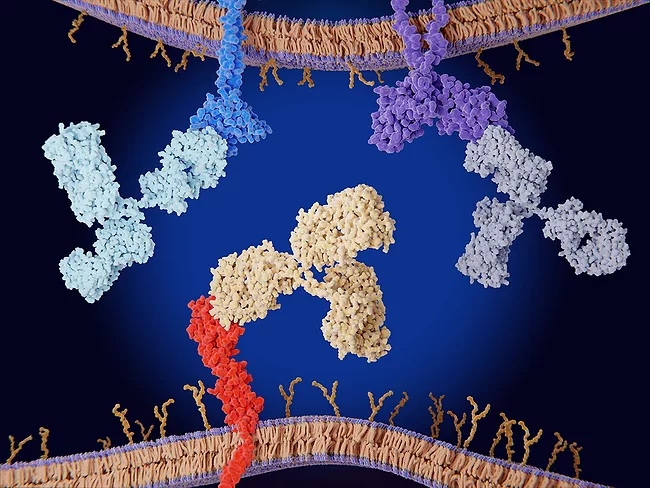
Five months after getting a complete response letter from the U.S. FDA, Regeneron Pharmaceuticals Inc. has landed conditional European marketing approval for odronextamab, a bispecific antibody for treating lymphoma. Now named Ordspono, the approval is for treating adult patients with relapsed or refractory follicular lymphoma or diffuse large B-cell lymphoma, after two or more lines of therapy. The European Commission also approved Merck & Co. Inc.’s Winrevair (sotatercept) for pulmonary arterial hypertension and ARS Pharmaceuticals Inc.'s Eurneffy (inhaled epinephrine) for anaphylaxis.
Merck & Co. Inc. is acquiring Curon Biopharmaceutical Ltd.’s bispecific antibody CN-201 that targets CD3 and CD19 for B-cell associated diseases, for up to $1.3 billion. Under the terms of the deal, Merck (known as MSD outside of North America) through a subsidiary will acquire full global rights to CN-201 for an up-front payment of $700 million in cash. Curon is also eligible to receive up to $600 million in development and regulatory-based milestone payments. The deal is expected to close in the third quarter of 2024.
In turning the U.S. Department of Health and Human Services’ (HHS) one initial defeat into a victory, a federal district court handed HHS a 7-0 record in getting constitutional challenges to Medicare price negotiations dismissed.