Ubiquigent Ltd. has signed an agreement with Debiopharm International SA to support the development of Debiopharm’s preclinical ubiquitin carboxyl-terminal hydrolase 1 (USP1) inhibitor program, Debio-0432.
Defence Therapeutics Inc. has announced the successful testing of a second-generation anticancer vaccine, ARM-002, using its lead anticancer molecule Accutox. When tested as a therapeutic vaccine in a melanoma cancer model, ARM-002 led to an 80% complete response when combined with an anti-PD-1 immune-checkpoint inhibitor.
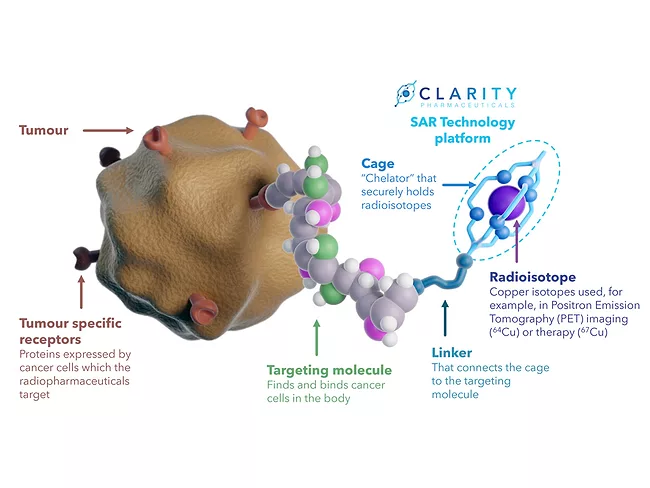
Clarity Pharmaceuticals Ltd. raised AU$121 million (US$79.29 million) through a private placement that will fund the company’s radiopharma pipeline comprising targeted copper therapies out to early 2026.
Kazia Therapeutics Ltd. has out-licensed paxalisib as a potential treatment for intractable epilepsy in focal cortical dysplasia type 2 and tuberous sclerosis complex disease in a carve-out deal with Sovargen Co. Ltd. for $20.5 million plus sales royalties.
Triarm Therapeutics Ltd. is on a mission to democratize CAR T therapies to make them more accessible and affordable, Triarm CEO Jay Zhang told BioWorld. “Nearly half of the patients eligible for CAR T therapies still cannot get treated, and the main reason is the expense, and the second is they cannot afford to wait.
As investment in Asia biohubs continues into 2024, Merck KGaA’s Milliporesigma is the latest to drop more than €300 million (US$328 million) into a new bioprocessing production center in Daejeon, South Korea.
Nuvation Bio Inc. said on March 25 it will acquire Anheart Therapeutics Ltd., a U.S.- and China-based precision oncology company, in an all-stock transaction, adding Anheart’s ROS1-inhibiting lung cancer drug, taletrectinib (AB-106), to its pipeline.
One of the building blocks for newly launched Clasp Therapeutics Corp. is making the right patient choices for treatment. If those who receive the company’s therapy are correctly identified, CEO Robert Ross told BioWorld, it will have a profound effect on outcomes. The missing link in cancer treatment, Ross added, was how to identify a patient, something he said Clasp is able to do.
University of Nebraska has described SF-2523 derivatives acting as dual inhibitors of bromodomain-containing protein 4 (BD2 domain) (BRD4 BD2) and phosphatidylinositol 3-kinase (PI3K) reported to be useful for the treatment of medulloblastoma and fibrosis.
 RSS
RSS