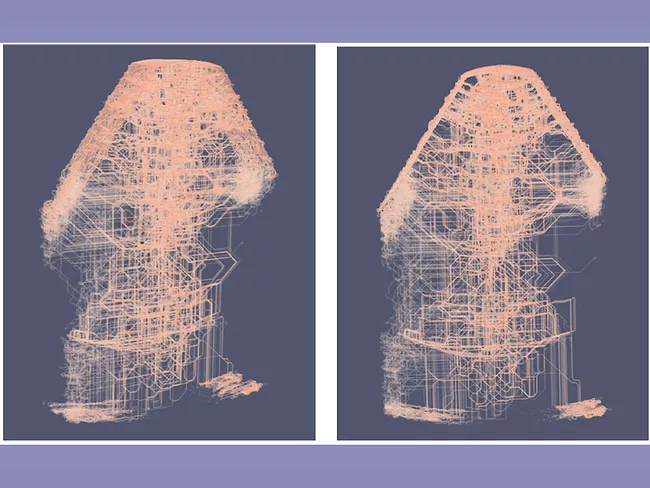
PERTH, Australia – With a fresh injection of A$28.9 million (US$22.4 million) in grant funding from the Australian government and a capital raise of A$40 million, 4dmedical Ltd. is well on its way to commercializing its first lung imaging product in the U.S. and Australia. 4dmedical’s X-ray velocimetry (XV) technology is the first FDA-cleared respiratory imaging solution that uses mathematical models and algorithms to convert sequences of X-ray images into four-dimensional quantitative data.
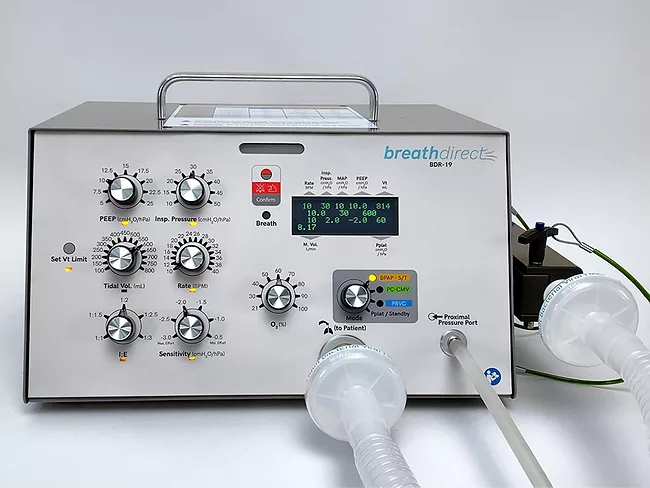
The U.S. FDA has granted emergency use authorization (EUA) to Breath Direct Inc. for its BDR-19 critical care ventilator for the treatment of critical care patients with respiratory insufficiency. Initial shipments of the device are expected within weeks. The EUA marks a major milestone for the fledgling Long Beach, Calif.-based company, which was started by medical device entrepreneur Darren Saravis in the early days of the pandemic.
MIT Media Labs spinoff Empatica Inc. secured the CE mark for its Aura system, a wearable solution for the monitoring and early alert of respiratory infections, including COVID-19. For use with people 14 and older, Aura is commercially available in Europe and the U.K., and for pilot purposes in the U.S. – pending FDA authorization. Aura’s algorithm analyzes vital signs from Empatica smartwatches, comparing data against the wearer’s historical baselines. In validation studies, Aura was able to detect patients with possible H1N1 influenza, rhinovirus or SARS-CoV-2 infection with 0.94 sensitivity. Detection occurred on average two days after infection.
Medi-Scan Inc. has emerged from stealth mode with cloud-based software that converts the data on ultrasound analog 2D grayscale images into a digital 3D high-definition (HD) format in less than two minutes. The company is currently focusing its efforts on the heart and lungs, with the aim of providing quick, point-of-service evaluation and triaging of patients with heart disease and other conditions, including COVID-19.
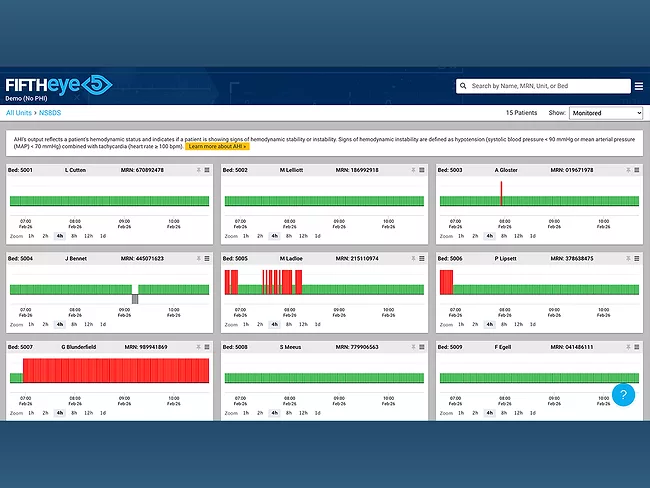
The FDA has granted de novo authorization to Fifth Eye Inc. for its Analytic for Hemodynamic Instability (AHI), a machine learning (ML)-based, real-time indicator of patient deterioration. Commercialization of the software device, which continuously monitors patients with an electrocardiogram (ECG) for signs of deterioration, got underway on March 1.
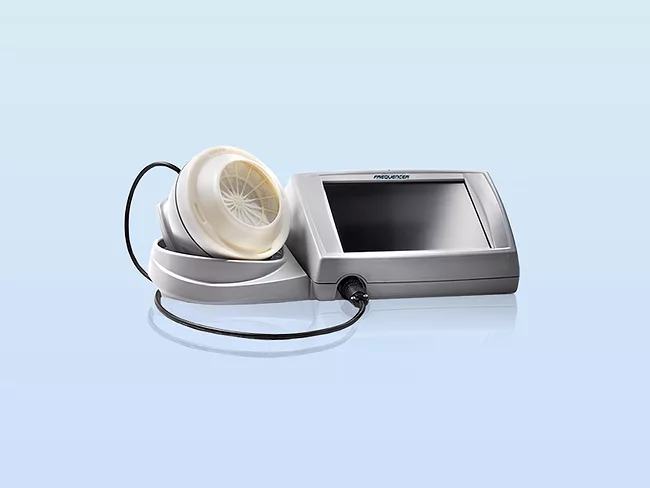
TORONTO – An airway clearance device that uses acoustic sound waves to treat lung disorders and respiratory infections like cystic fibrosis (CF) is now being used to clear the lungs of patients suffering very badly from COVID-19. Developed by Montreal-based Dymedso Inc., more than 675 Frequencer acoustic devices currently being utilized across the world are assisting COVID-19 patients by removing mucous and secretions from their lungs and smaller airways.
TORONTO – The Medipines AGM100, which was developed by Orange County, Calif.-based Medipines Corp. to detect respiratory impairment caused by chronic obstructive pulmonary disease (COPD), has been recruited in the fight against COVID-19 in Canada. Described by company CEO and coinventor Steve Lee as “the world's first noninvasive lung monitor for gas exchange measurement,” the device is undergoing advanced testing.
Airehealth Inc.'s management took a deep breath on hearing that the company's Vitalmed nebulizer received U.S. FDA 510(k) clearance after waiting nearly 11 months. The portable, electronic, vibrating mesh nebulizer will connect to the Orlando, Fla.-based company's diary companion app early next year as part of an integrated suite of products designed to help individuals with chronic respiratory issues track symptoms and better manage their care.
With hospitalizations rapidly rising as the COVID-19 pandemic washes across the world in a winter wave, researchers are racing to develop treatments that protect the increasing number of ventilated patients. One option focuses on protecting muscles critical to breathing.
With the world experiencing another wave of the coronavirus pandemic that threatens to overwhelm hospitals and testing capacity, the ability to quickly diagnose COVID-19 based on alternative methodologies has become increasingly important. For patients with respiratory symptoms, review of CT scans emerged as a relatively reliable indicator of infection with SARS-CoV-2 from the first days of its emergence, but the need for more accurate readings remains.
 RSS
RSS