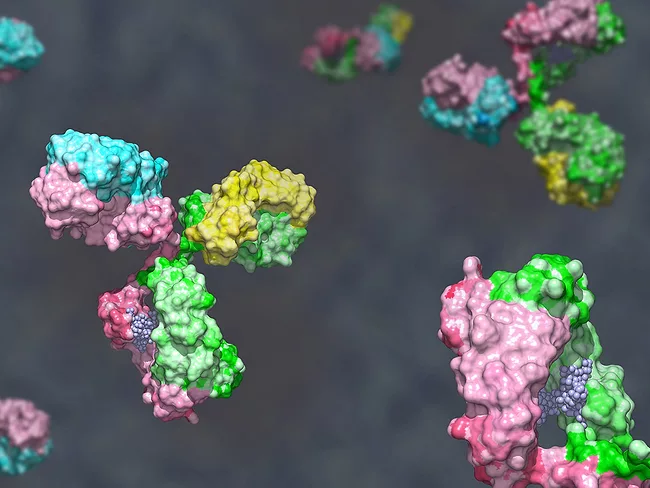
Neok Bio Inc. was formed earlier this year and is already on schedule to file an IND in a few months for its two bispecific antibody-drug conjugates (ADCs) to treat various types of tumors. The biotech got a leg up on development from its principal investor, Korean biotech ABL Bio Inc., where the discovery work was accomplished.
Celltrion Inc. scored a hat-trick of deals to license new antibody candidates, including a $744 million deal with Kaigene Inc. Nov. 3, and a near $500 million deal with Mustbio Co. Ltd. Oct. 31.
Neok Bio Inc. was formed earlier this year and is already on schedule to file an IND in a few months for its two bispecific antibody-drug conjugates (ADCs) to treat various types of tumors.
Qyuns Therapeutics Co. Ltd. signed a potential $1.07 billion license deal with Roche Holding AG, granting the latter exclusive rights to QX-031N – a human thymic stromal lymphopoietin and interleukin-33)-targeting bispecific antibody.
Qyuns Therapeutics Co. Ltd. signed a potential $1.07 billion license deal with Roche Holding AG, granting the latter exclusive rights to QX-031N – a human thymic stromal lymphopoietin and interleukin-33)-targeting bispecific antibody.
Researchers at Alligator Bioscience AB and Lund University have developed a bispecific therapeutic antibody, ATOR-4066, that simultaneously targets the immune cell receptor CD40 and the tumor antigen CEACAM5.
Genmab A/S is paying $8 billion to acquire Merus NV, gaining rights to the latter’s phase III-stage petosemtamab, a bispecific antibody initially in development for head and neck cancer, and continuing the firm’s strategy to transition from a royalty-based operation to a fully integrated biopharma.
The first new U.S. FDA-approved therapeutic option for PTSD in more than 20 years will have to wait. A supplemental NDA seeking approval of Rexulti (brexpiprazole) combined with sertraline, filed by one of Japan’s biggest pharmas, Otsuka Pharmaceutical Co. Ltd., received a complete response letter (CRL) from the agency.
To say the team at Ollin Biosciences Inc. has some experience in ophthalmology would be an understatement. The company, which emerged from stealth with $100 million in venture capital and two in-licensed assets with plans to add more, brings to the table years of expertise from work on blockbuster retinal disease drugs Lucentis (ranibizumab, Roche AG) and Vabysmo (faricimab, Roche AG).
 RSS
RSS