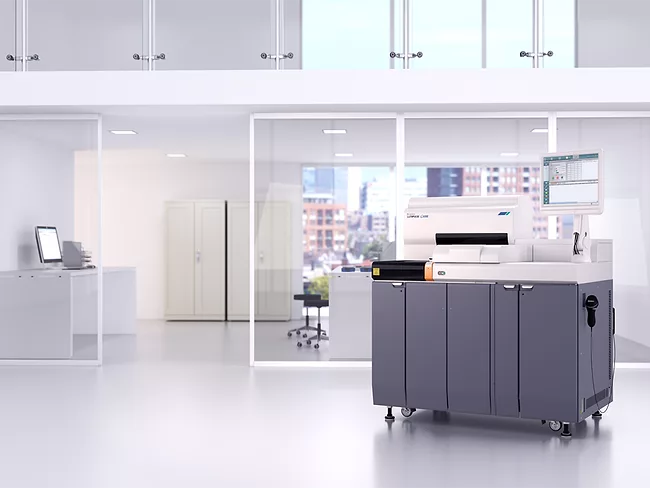
Recent advances in biomarkers and imaging capabilities have improved the diagnosis of Alzheimer’s disease (AD). Fujirebio Diagnostics Inc. aims to further expand the arsenal of AD diagnostics with its Lumipulse G β-Amyloid Ratio (1-42/1-40) in vitro diagnostic test. On Wednesday, the company said it had filed a 510(k) submission with the U.S. FDA for premarket clearance of the Lumipulse G β-Amyloid IVD.
The latest global regulatory news, changes and updates affecting medical devices and technologies, including: FDA slaps two companies for illicit COVID offerings; FDA approves new PET imaging agent for prostate cancer.
Cerus Corp. has received the green light from the U.S. FDA for its Intercept blood system for cryoprecipitation. The device, which garnered a breakthrough device designation in 2018, is used to produce Pathogen Reduced Cryoprecipitated Fibrinogen Complex (PR-Cryo) for treating and controlling bleeding, including massive hemorrhage, associated with fibrinogen deficiency.
The latest global regulatory news, changes and updates affecting medical devices and technologies, including: GAO, National Academies report on AI in health care; Commerce begins assessment of U.S. drug, device manufacturing base.
Investors in Minerva Neurosciences Inc. on Dec. 1 gave a chilly reception to reported FDA feedback on the company's experimental treatment for the negative symptoms in schizophrenia, roluperidone. Though the drug failed to deliver statistically significant differences vs. placebo in a phase III study this year, CEO Remy Luthringer outlined a potential path to NDA filing for the candidate using a modified intent-to-treat analysis of the trial and evidence from other ongoing evaluations.
The U.S. FDA’s device user fee schedule doubled for both the third and fourth user fee agreements over the prior iterations, but the pressure against another doubling for the fifth iteration of the user fee program is mounting. The Medical Imaging & Technology Alliance (MITA) said it sees a need to retain the user fee programs that are working and to jettison any underperforming programs, adding that user fees “should be stabilized around current funding levels.”
The U.S. FDA has granted 510(k) clearance to Siemens Healthineers AG for AI-Rad Companion Organs RT, the newest module in its platform of artificial intelligence-based software assistants. The radiation therapy planning aide joins earlier AI-Rad Companion modules for interpreting magnetic resonance imaging (MRI) studies of the brain and prostate, as well as one for chest computed tomography (CT) studies.
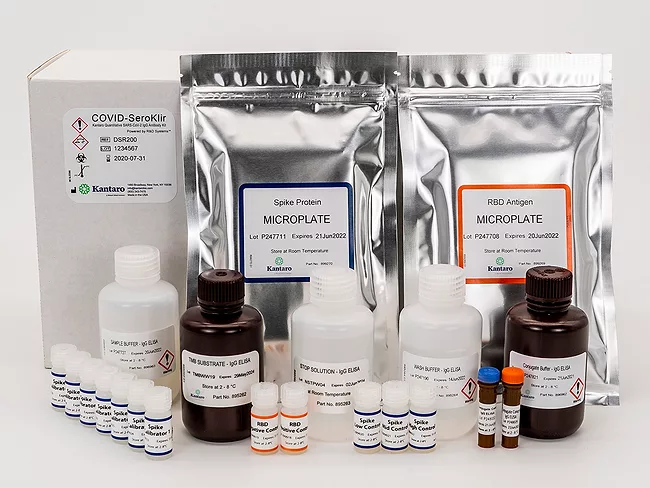
Kantaro Biosciences LLC, a joint venture between the Mount Sinai Health System and RenalytixAI, has received emergency use authorization from the U.S. FDA for its semi-quantitative SARS-CoV-2 IgG antibody test kit. Known as COVID-Seroklir, the test determines the presence and precise level of IgG antibodies. It has demonstrated 98.8% sensitivity and 99.6% specificity for detecting SARS-CoV-2 specific IgG antibodies against two virus antigens, the full-length spike protein and its receptor-binding domain.
The latest global regulatory news, changes and updates affecting medical devices and technologies, including: FDA lists entities recognized under ASCA program.
Hologic Inc. has gained approval from the U.S. FDA to add a diagnostic claim to its HIV type 1 viral load monitoring assay. This makes the Aptima HIV-1 Quant Dx assay the first dual-claim assay in the U.S., allowing both viral load monitoring and diagnosis. For laboratories that use the assay, the dual claim allows for consolidated testing on one automated platform, adding to efficiency.
 RSS
RSS