Sarepta Therapeutics Inc. CEO Douglas Ingram said he expects “ferocious” demand for gene therapy Elevidys (delandistrogene moxeparvovec), granted full approval by the U.S. FDA for Duchenne muscular dystrophy (DMD). Shares of the Cambridge, Mass.-based firm closed June 21 at $16.72, up $37.22, or about 30% on the news.
Now that it has some experience with interchangeable biosimilars under its belt, the U.S. FDA is proposing an update to its interchangeability guidance that could eliminate the need for switching studies in some instances.
A nearly two-year-old partial clinical hold has been lifted by the U.S. FDA on PTC Therapeutics Inc.’s pivotal phase II study in Huntington’s disease. The agency had paused enrollment in October 2022, saying it wanted more data on PTC-518, an orally bioavailable small-molecule splicing modifier, before enrollment could continue.
After a rocky year, Akili Inc. received U.S. FDA clearance for use of its non-prescription product, Endeavorotc, for treatment of adults with attention deficit/hyperactivity disorder (ADHD). Endeavorotc employs a video game format to improve attention in individuals with inattentive or combined-type ADHD.
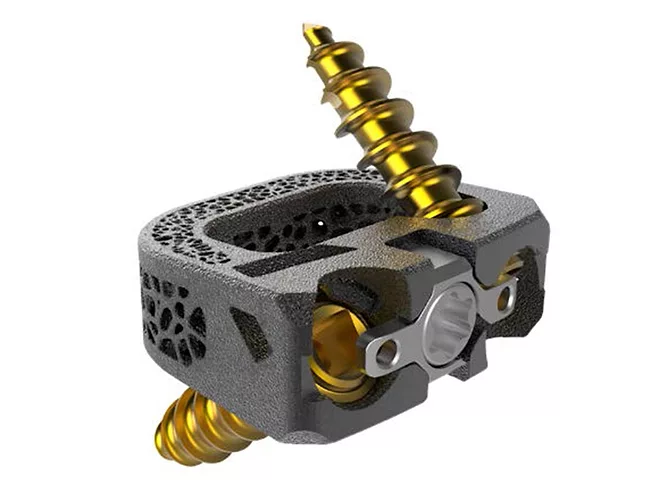
Inosys Korea Co. Ltd. gained U.S. FDA 510(k) clearance for Unispace, a cervical spine cage manufactured with 3D printing technology. Unispace can be used during spinal fusion surgery, Busan-based Inosys said, wherein operators can remove a patient’s diseased or damaged disc and replace it with the cervical cage to maintain the original length of the spine.
As competition rises in the Keytruda (pembrolizumab) biosimilar space, Celltrion Inc. is the latest to announce that it filed an IND application to the U.S. FDA to start a global phase III trial for its own Keytruda biosimilar, dubbed CT-P51. Incheon, South Korea-based Celltrion, which previously said it would differentiate from the pack by developing an easier-to-administer subcutaneous biosimilar of pembrolizumab, announced June 17 plans to start a global comparative phase III study of CT-P51 and Keytruda.
The deaths of two cancer patients treated with the small molecule azenosertib has prompted the U.S. FDA to place a partial clinical hold on a phase I study and two phase II studies from Zentalis Pharmaceuticals Inc. The deaths are presumed by Zentalis to be from sepsis. Both patients who died were in the phase II Denali study of platinum-resistant ovarian cancer.
For the time being, Madrigal Pharmaceuticals Inc.’s Rezdiffra (resmetirom) stands alone as the only U.S. FDA approved treatment for treating nonalcoholic steatohepatitis (NASH). But new and positive data from multiple companies show Madrigal may soon have company.
Becoming the first pneumococcal conjugate vaccine specifically designed for adults 18 and older, Merck & Co. Inc.’s 21-valent candidate, Capvaxive (V-116), gained U.S. FDA approval on its June 17 PDUFA date. The Rahway, N.J.-based company expects to take significant market share based on positive phase III findings from the Stride-3 trial. Analysts have estimated the product could reach $2 billion in annual global sales.
As competition rises in the Keytruda (pembrolizumab) biosimilar space, Celltrion Inc. is the latest to announce that it filed an IND application to the U.S. FDA to start a global phase III trial for its own Keytruda biosimilar, dubbed CT-P51. Incheon, South Korea-based Celltrion, which previously said it would differentiate from the pack by developing an easier-to-administer subcutaneous biosimilar of pembrolizumab, announced June 17 plans to start a global comparative phase III study of CT-P51 and Keytruda.
 RSS
RSS