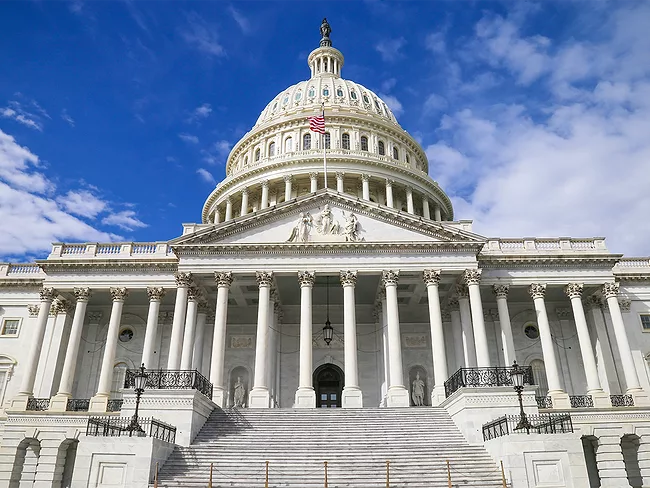
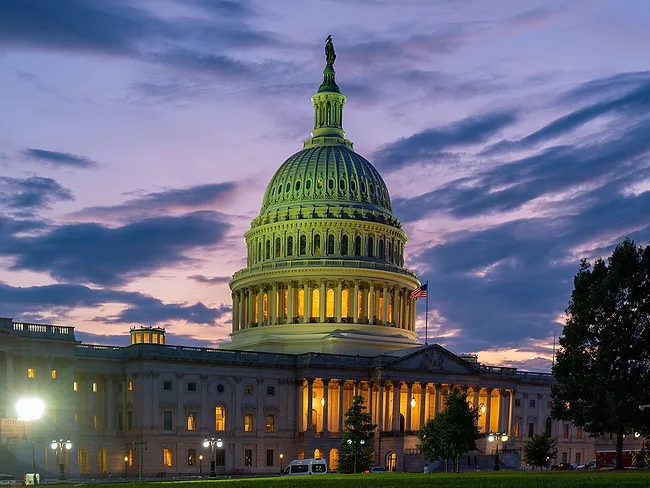
After the U.S. House passed a package of spending bills Jan. 22 to fund several agencies and departments, including Health and Human Services, through fiscal 2026, the Senate was expected to quickly follow suit to ensure that no part of the federal government would shut down when the current continuing resolution expires Jan. 30. That was before a confrontation with Immigration and Customs Enforcement in Minnesota turned deadly over the weekend.
The U.S. NIH may be weathering the budget storm thanks to bipartisan congressional support, but another squall line is forming on the horizon over politicization of the research agency.
The good news is that the U.S. Congress is on track to pass a slate of fiscal 2026 spending bills before the current continuing resolution expires Jan. 30. So, barring any last-minute disputes or legislative hostage-taking, there should be no repeat of last year’s 43-day shutdown that impacted NIH grants and activities.
Unless the U.S. Supreme Court steps in to reverse the decision, the NIH’s attempt to cap indirect costs at 15% in all its grants is dead. The U.S. Court of Appeals for the First Circuit upheld a permanent injunction Jan. 5 that was issued by a lower court, vacating an NIH supplemental guidance imposing the across-the-board cap both retroactively and prospectively.
Unless the U.S. Supreme Court steps in to reverse the decision, the NIH’s attempt to cap indirect costs at 15% in all its grants is dead. The U.S. Court of Appeals for the First Circuit upheld a permanent injunction Jan. 5 that was issued by a lower court, vacating an NIH supplemental guidance imposing the across-the-board cap both retroactively and prospectively.
In 2025, science saw its breakthroughs, which BioWorld will be covering as part of our end-of-the-year wrap-up. But the biggest science story of 2025 is not about any scientific advance. It is the politicized destruction of U.S. science, and the dismantling of a scientific ecosystem that has been the envy of the world since it emerged after Germany destroyed its own pre-eminence in the 1930s.
Over a span of five-and-a-half months this year, 3.5% of the more than 11,000 clinical trials funded by the U.S. NIH had their grants terminated, according to an article published in the Nov. 17 JAMA Internal Medicine. That’s 383 trials that lost funding.
A year ago, BioWorld published a special series on the women’s health drug development ecosystem, showing that while women make up half of the population, venture capital investment and life sciences partnerships in the space – specifically those deals supporting innovations for conditions primarily affecting women – pale in comparison to efforts addressing diseases more men experience. That appears to be changing, according to an updated look of BioWorld data, supported by findings in the Silicon Valley Bank 2025 Innovation in Women’s Health Report published in April, and Clarivate’s Nov. 13 release of its latest Companies to Watch 2025 report, Rediscovering women’s health.
Despite down-to-the-wire negotiations, the odds are that parts of the U.S. government will shut down at midnight Sept. 30, as Senate Democrats refused to support a seven-week, clean continuing resolution already passed by the House to keep the government funded while Congress hammers out fiscal 2026 spending bills.
Rakuten Medical Inc. is advancing a pipeline of solid tumor therapeutics built on its Alluminox platform worldwide, having gained conditional early approval of ASP-1929, an Alluminox-derived photoimmunotherapy, in Japan in 2020.
 RSS
RSS