The discovery of the ‘Warburg effect’ more than 80 years ago implied that inhibiting tumor cells’ ability to consume abnormally large amounts of glucose could prevent them from growing. Taking advantage of the fact that hexokinase-2 catalyzes the first step of glucose metabolism, researchers at Yıldız Teknik Üniversitesi and collaborators identified novel derivatives of the hexokinase-2 inhibitor lonidamine and identified at least one that was potentially more potent and less toxic.
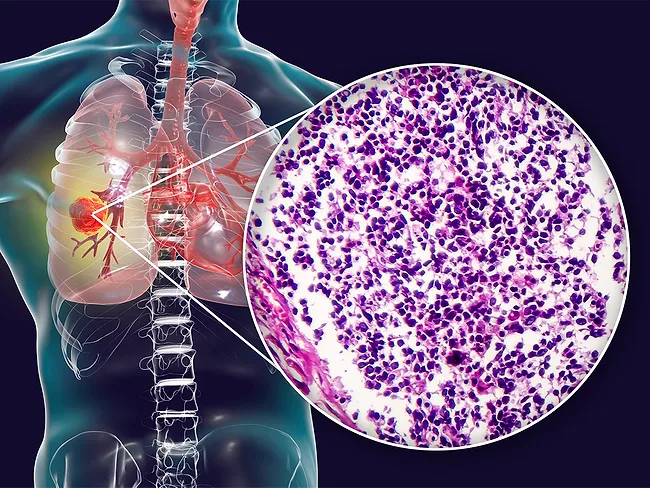
Small-cell lung cancer (SCLC) and some other cancers involve dysregulation of the transcription factor E2F, and apoptosis can be induced in those cells by blocking the interaction of the RxL sequence motif in E2F with cyclin A, which leads to hyperactivation of E2F. Researchers from Dana-Farber Cancer Institute and collaborators have developed macrocyclic peptides that inhibit this interaction and thereby hyperactivate E2F, leading to anticancer activity in various preclinical systems.
Despite having lower smoking habits than other groups in the U.S., Black Americans are more likely to develop lung cancer, and their survival rates are significantly worse. What explains this disparity? Scientists at Vanderbilt University Medical Center have analyzed the genetics of their African ancestry in search of risk genes related to the disease and tobacco use. The results reveal new risk factors and confirm the presence of genetic variants that may contribute to the greater impact of lung cancer in this population.
Inventisbio Co. Ltd. and Inventisbio LLC have divulged Werner syndrome helicase (WRN; RECQ3; RECQL2) inhibitors reported to be useful for the treatment of cancer.
Jazz Pharmaceuticals Ireland Ltd. has identified compounds acting as GTPase KRAS and its mutant inhibitors reported to be useful for the treatment of cancer.
Certa Therapeutics Pty Ltd. has disclosed ovarian cancer G-protein coupled receptor 1 (GPR68; OGR1) antagonists reported to be useful for the treatment of cancer, inflammation and fibrosis.
Oncolytic viruses are being actively explored as cancer therapies because they preferentially infect tumor cells and cause their lysis. At the same time, the viruses can accommodate transgenes that can stimulate anti-cancer responses in the local tumor microenvironment.
Despite the success of traditional viral-based CAR T-cell therapies against several blood malignancies, their efficacy remains limited against solid tumors. Non-viral engineering of CAR T cells using electroporation or lipid nanoparticle delivery of CAR-encoding mRNA achieves high but transient CAR expression, highlighting the limitations of current preclinical models for evaluating mRNA-based CAR T cells.
Arc Therapies Inc., a startup from the National Cancer Center Japan, has initiated research of YB328, a newly identified gut microbe, toward clinical application. The company has designated the YB328 strain as ARC-0812 (RUX: Lux) and will proceed with preclinical and clinical trials to explore its role as an immune adjuvant in cancer immunotherapy.
 RSS
RSS