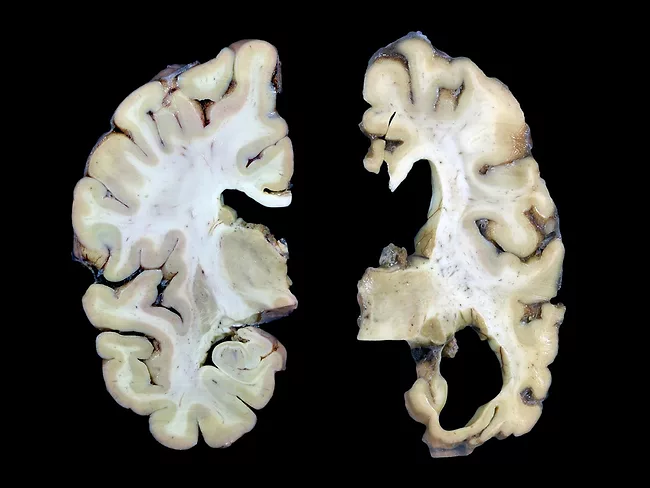
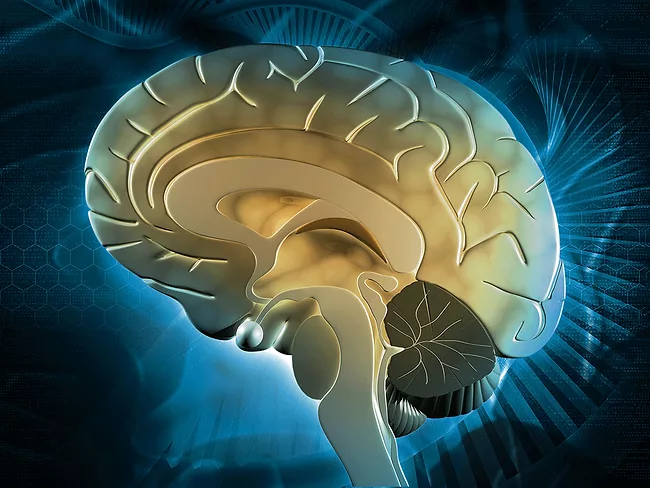
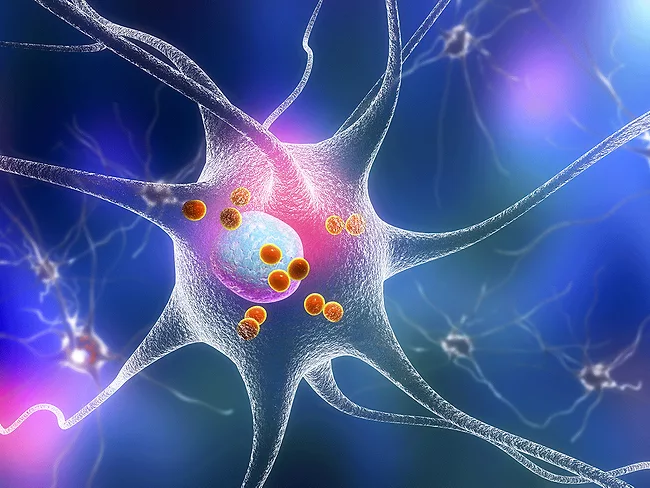
Variants in a newly discovered microprotein affected the risk of Alzheimer’s disease more than any other known risk variant besides ApoE. The protein, dubbed SHMOOSE by its discoverers, was identified in a mitochondrial-wide association study (miWAS). The researchers reported their findings in the Sept. 21, 2022, issue of Molecular Psychiatry. The newly identified variant is not rare – it occurs in about a quarter of the Caucasian population, slightly more than the ApoE4 allele. Its effects are also not subtle – in their paper, the team estimated that those with the high-risk variant SHMOOSED47N were roughly 30% more likely to develop AD than those without.
The mutant gene causing Huntington’s disease (HD) is active from the earliest stages of brain development, even though the pathology is not evident until between 30 and 50 years of age. That delay is ascribed to plasticity enabling the brain to compensate to such an extent that overt signs of disease take time to develop. As a result, it is difficult to plot a route from early molecular defects to development of HD several decades later.
A series of novel tacrine derivatives acting as acetylcholinesterase inhibitors and N-methyl-D-aspartate (NMDA) receptor subtype antagonists has been developed in research seeking to exploit these targets for the treatment of Alzheimer's disease.
Researchers from the U.K. have investigated the specificity and sensitivity of clonidine growth hormone (GH) as a biomarker for the differential diagnosis of multiple system atrophy (MSA) from pure autonomic failure (PAF), Parkinson’s disease (PD) and progressive supranuclear palsy (PSP).
Recent efforts have unveiled UCB-0022 (UCB Pharma Inc.) as an oral, brain-penetrant small molecule acting as a selective D1 positive allosteric modulator.
Researchers from the University of Santiago de Compostela and University of Porto have reported the discovery of a novel acetylcholinesterase (AChE) inhibitor, MJM-255.
Iama Therapeutics Srl has sought new, selective inhibitors of solute carrier family 12 member 2 (NKCC1) to treat autism, Down syndrome and brain disorders featuring chloride (NKCC1/solute carrier family 12 member 5 [KCC2]) imbalance.
Frontotemporal dementia (FTD) and amyotrophic lateral sclerosis (ALS) are two devastating neurodegenerative diseases, with clinical, pathological and genetic overlap, without effective therapy.
Therapeutic Solutions International Inc. has announced promising data on the use of Campbellcell for treatment of bipolar disorder by the company's suicide prevention-based spin-off Campbell Neurosciences Inc.

 RSS
RSS