The level of investment in Europe’s med-tech sector in 2025 did not materialize as many had hoped at the beginning of the year. Reciprocal tariffs introduced by the U.S. government created an uncertain macroeconomic environment, curtailing dealmaking and slowing financing activity. Nevertheless, amid uncertainty, there were some bright spots as medical devices remain essential, and investors know how to navigate market cycles.
The U.S. Office of the National Coordinator has proposed to significantly whittle back the regulations pertaining to electronic health records, changes that would save small businesses significant sums in terms of compliance activities.
Livsmed Inc. closed the year’s biggest Kosdaq IPO with a ₩135.85 billion (US$94 million) haul Dec. 24. Livsmed specializes in the development of hand-held multi-joint laparoscopic surgical instruments for minimally invasive procedures.
Med-tech happenings, including deals and partnerships, grants, preclinical data and other news in brief: Azenta, Bluejay Diagnostics, Establishment Labs Holdings, Thelema, Work Medical Technology.
The U.S. FDA’s final rule for regulation of lab-developed tests was destined to be controversial at best and exceptionally susceptible to legal challenge according to more than one legal opinion. The inevitable legal challenge succeeded wildly in a decision rendered in district court in March 2025, marking one of the rare instances in which the courts thwarted FDA rulemaking and thus is easily the regulatory story of the year for 2025. Attempts to regulate AI in the U.S. and Europe also dominated the regulatory landscape.
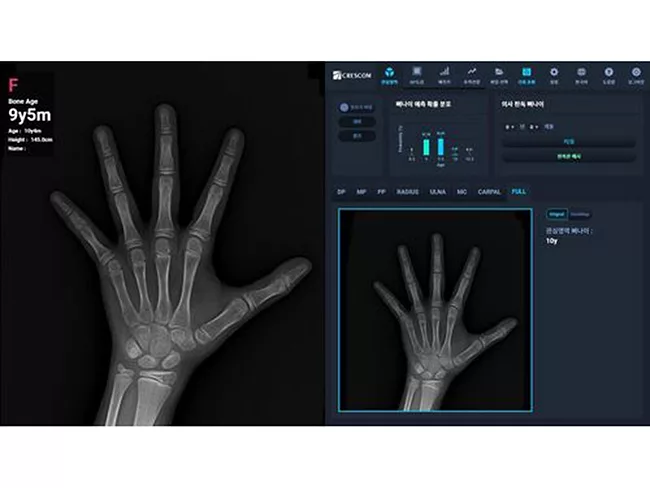
Crescom Co. Ltd., an AI musculoskeletal imaging company, gained U.S. FDA 510(k) clearance Dec. 24 for MediAI-BA, its AI-powered pediatric and adolescent bone age analysis software.
Classified as a class II medical device, MediAI-BA evaluates bone age and suggests predicted adult height based on growth plate status assessed by hand and wrist X-ray imaging. Prior clinical trial results demonstrated MediAI-BA had specialist-level accuracy, recording a mean absolute deviation (MAD) of 0.39 years.
 RSS
RSS