“I am not a fortune teller, nor am I a gambler. I will make no bets,” Lorraine Kalia told the audience at the 2023 International Congress of Parkinson’s Disease and Movement Disorders. “But I am optimistic.” At the meeting, which is being held in Copenhagen this week, Kalia, who is a scientist at Toronto Western Hospital’s Krembil Brain Institute and at the University of Toronto’s Tanz Centre for Research in Neurodegenerative Diseases, was giving an overview of “Emerging targets in the clinic” in a plenary session on “Therapeutic strategies for the future.”
“The size of a chromosome does not correlate with complexity of the sequences within,” Jackson Laboratory professor Charles Lee told BioWorld. Which is why the Y chromosome, which is the runt of the litter as far as human chromosomes are concerned, was the last to be fully sequenced. Now, 20 years after publication of the first near-complete human genome sequence and 16 months after the telomere to telomere (T2T) consortium announced it had completed “gapless assemblies for all chromosomes except Y,” of the human genome, it really is done.
Investigators have functionally linked the Alzheimer’s disease (AD) risk gene SORL1 to apolipoprotein E (ApoE) and clusterin, another apolipoprotein. The work, Tracy Young-Pearse told BioWorld, is part of an attempt to “try to understand different subtypes of Alzheimer’s disease.” It maps some of what Young-Pearse termed the “many molecular roads that lead to Alzheimer’s” – which, in turn, is the first step to setting up roadblocks. Young-Pearse is an associate professor in the Ann Romney Center for Neurologic Diseases at Brigham and Women’s Hospital and Harvard Medical School and co-leader of the Harvard Stem Cell Institute’s Nervous System Diseases Program. She is also the senior author of the paper describing the findings, which appeared online in Cell Reports on Aug. 22, 2023.
By using machine learning techniques to scour electronic health records, researchers have identified individuals who were likely to have binge eating disorder (BED) but had not received a formal diagnosis. Genomewide association studies including such patients enabled the investigators to identify several risk variants that were correlated with BED irrespective of body mass index (BMI), which covaries with BED and is a potential confounding factor.
An experimental vaccine that contained antigens of both lytic and latent phases of Epstein-Barr virus (EBV), and induced both an antibody and a T cells response, was able to generate broad and long-lasting immunity against EBV in mouse models of infection. Researchers from the QIMR Berghofer Medical Research Institute and Elicio Therapeutics Inc. reported those results online in Nature Communications on Aug. 8, 2023.
For some viruses, the challenge to developing a vaccine is their rapid mutation rate. This is the major challenge to developing an HIV vaccine or a universal flu vaccine. EBV is different. Its superpower is its ability to hide.
Swiss researchers have gained new insights into the relationship between aging, inflammation, neurodegeneration and cognitive decline. EPFL professor Andrea Ablasser and her team showed that brain aging was driven by microglial activation of the cGAS/STING pathway.
Protein quality control research is “almost exclusively focused on heat shock proteins, which are ubiquitously present” up and down the evolutionary chain, Xiaolu Yang told BioWorld. But “for more sophisticated organisms, which we humans like to think we are, it’s a little odd that we still use the system that bacteria started with…. It seems like we should have something more. The TRIM system,” he added, “fills that gap.”
Protein quality control research is “almost exclusively focused on heat shock proteins, which are ubiquitously present” up and down the evolutionary chain, Xiaolu Yang told BioWorld. But “for more sophisticated organisms, which we humans like to think we are, it’s a little odd that we still use the system that bacteria started with…. It seems like we should have something more. The TRIM system,” he added, “fills that gap.”
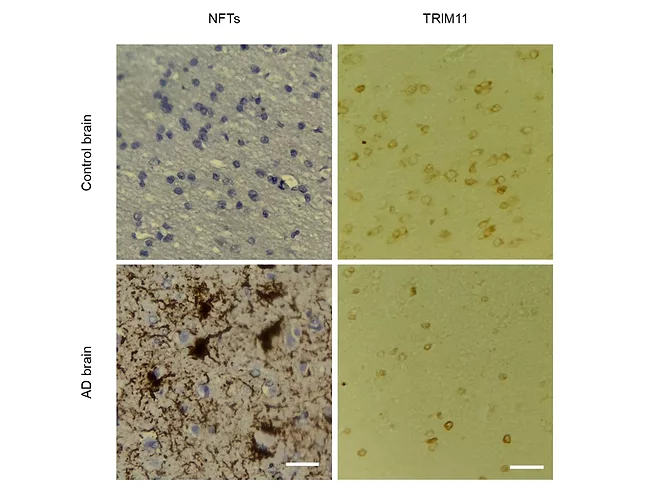
TRIMs or tripartite motif proteins are a group of quality control proteins that are found only in animals. One of their functions is to add ubiquitin tags to proteins, marking them for transport to the proteasome system. TRIMs are part of the innate antiviral defense system. But in the July 27, 2023, issue of Science, Yang, who is a professor of cancer biology in the Perelman School of Medicine at the University of Pennsylvania, and his colleagues reported that TRIM11 interacts with tau protein in multiple ways that were beneficial in preventing tauopathies.
Transplanted human glial cells could outcompete human glia in a chimeric mouse model of Huntington’s disease, inducing apoptosis. And younger health cells could outcompete older ones. The findings, which appeared online in Nature Biotechnology on July 17, 2023, help pave the way for testing glial cell transplantation as a therapeutic strategy in neurodegenerative disorders.
In brain research, be it basic or clinical, neurons have long hogged the limelight. But at the 2023 European Meeting on Glial Cells in Health and Disease, neurons take a back seat to glia – cell types that have often been described as support cells and treated as an afterthought, but that play critical roles in all aspects of brain function, including information processing.