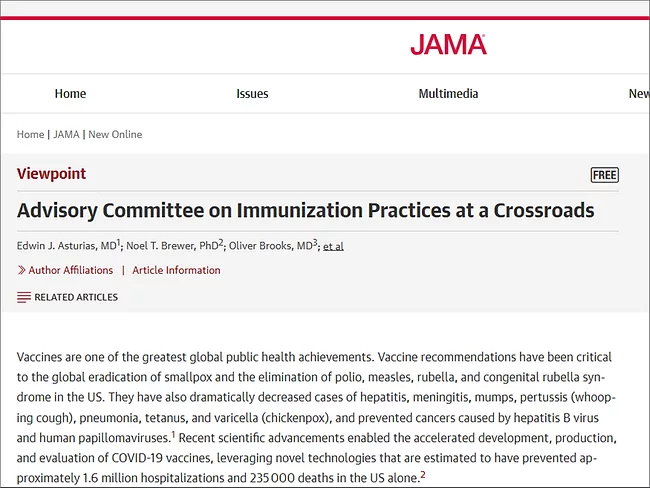
The 17 members abruptly terminated June 9 from the U.S. CDC’s Advisory Committee for Immunization Practices are not going gently into the night. Instead, they’re raging against what could be the dying of the light.
After years of conversations surrounding indirect research costs, academic groups are now under the gun to quickly come up with an alternative to the NIH’s proposed 15% across-the-board cap on indirect costs and the decades-old university-by-university negotiated rate that can exceed a 50% add-on to a grant.
The 17 members abruptly terminated June 9 from the U.S. CDC’s Advisory Committee for Immunization Practices (ACIP) are not going gently into the night. Instead, they’re raging against what could be the dying of the light. The 17 raised their collective voices in a June 16 JAMA opinion piece to decry what’s at stake with Health and Human Services Secretary Robert Kennedy’s efforts, in his words, to “reestablish public confidence in vaccine science” by cleansing ACIP of what he claimed were conflicts due to members’ financial ties to industry.
And then there were eight. That is, eight members of the U.S. CDC’s Advisory Committee for Immunization Practices (ACIP).Two days after dismissing the 17 members of the committee, Health and Human Services Secretary Robert Kennedy named eight new members to the panel. Eight is the minimum required for a quorum, which will be necessary for the June 25-27 ACIP meeting.
When it comes to the U.S. biopharma market, pricing seems to be the driving focus of most congressional conversations – and government contracts. Rep. Cliff Bentz, R-Ore., hit pause on that conversation at a June 11 House subcommittee hearing on the drug supply chain, when he asked if the U.S. is sacrificing security for price.
Despite the June 9 gutting of the U.S. CDC’s Advisory Committee for Immunization Practices, the Department of Health and Human Services said the committee’s June 25-27 meeting will continue as scheduled. But a new panel has yet to be named, and typically ACIP members have a lot of behind-the-scenes work to do before a meeting.
Absent extraordinary circumstances, the Patent Trial and Appeal Board “should never cancel claims it has not determined to be unpatentable as a sanction” for misconduct during a board proceeding, according to the acting director of the U.S. Patent and Trademark Office (USPTO).
Children with solid tumors who relapse are being treated with the same chemotherapy they would have been given 40 years ago, as “there have been no major approvals for pediatric solid tumors,” Catherine Bollard, senior vice president and chief research officer at Children’s National Hospital, said at a June 5 FDA roundtable on cell and gene therapies (CGTs). The problem isn’t the science. Bollard said many groups are working on curative CGTs “for these children who have lost all other hope for survival.” The real gap is that “big pharma doesn’t see the business model because it’s a rare disease,” she added.
The U.S. FDA gave Sarepta Therapeutics Inc.’s rAAVrh74 viral vector, used in an investigational gene therapy for the treatment of limb-girdle muscular dystrophy, a step up, making it one of the first platforms to receive the agency’s platform technology designation.