As the number of mega-mergers have increased in recent years, and the purchase price of innovative companies rises, it is apparent that many lucrative buyouts fail to meet expectations, although a few outperform from time to time.
The acquisition of Karuna Therapeutics Inc. by Bristol Myers Squibb Co. (BMS) was announced in December 2023, and closed as the BioEurope Spring meeting was convening in March. Along with the acquisition of Cerevel Therapeutics Inc. by Abbvie Inc., the deal signaled that big pharma companies were ready to get back into the brain diseases space.
Abbvie Inc.’s much-hyped emraclidine, the centerpiece of its $8.7 billion buyout of Cerevel Therapeutics Inc., failed to hit its endpoints in two phase II trials in schizophrenia, sending company shares (NYSE:ABBV) down more than 12.6%, to close at 174.43, catching industry watchers by surprise and removing a potentially near-term competitor for Bristol Myers Squibb Co.’s recently approved antipsychotic, Cobenfy (xanomeline-trospium).
Biopharma deals and M&A activity in 2024 continued to surge past the last two years, with deal value in the first three quarters jumping 14.5% year-over-year. The total climbed from $130.38 billion through 3Q23 to an impressive $149.24 billion so far in 2024, the highest value in the first nine months of a year, according to BioWorld’s records. Q3 alone saw $49.81 billion in deals, following a strong Q2 at $55.26 billion. Meanwhile, M&As skyrocketed 75.5% in 2024, hitting $98.02 billion, up from $55.82 billion during the first nine months of last year.
Biopharma deals and M&A activity in 2024 continued to surge past the last two years, with deal value in the first three quarters jumping 14.5% year-over-year. The total climbed from $130.38 billion through 3Q23 to an impressive $149.24 billion so far in 2024, the highest value in the first nine months of a year, according to BioWorld’s records. Q3 alone saw $49.81 billion in deals, following a strong Q2 at $55.26 billion. Meanwhile, M&As skyrocketed 75.5% in 2024, hitting $98.02 billion, up from $55.82 billion during the first nine months of last year.
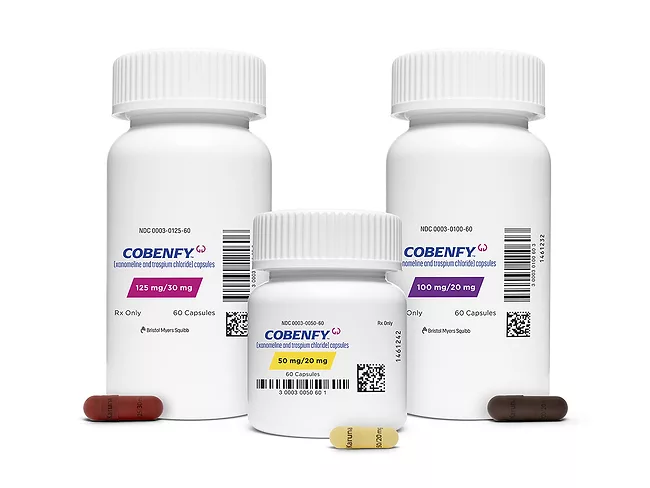
The FDA has approved Cobenfy, a dual M1/M4 muscarinic agonist that offers a fundamentally different approach to treating schizophrenia. The fixed dose combination of xanomeline-trospium is the first to act via a novel mechanism for the serious psychiatric disorder in over 50 years, finally expanding the treatment options beyond dopamine-targeted therapies. Bristol Myers Squibb Co., which acquired Cobenfy developer Karuna Therapeutics Inc. for $14 billion in a deal that closed in March 2024, said the drug will be available in the U.S. from late October.
Cerevel Therapeutics Inc. has identified compounds acting as muscarinic M4 receptor agonists reported be useful for the treatment of pain, sleep disorders, schizophrenia, substance abuse and dependence, drug-induced dyskinesia, and Alzheimer's and Parkinson's disease.
A schizophrenia drug in Cerevel Therapeutics Inc.’s lineup understandably stole much of the thunder during coverage of Abbvie Inc.’s takeover late last year to the tune of $8.7 billion, but much further back in the pipeline awaits another potentially lucrative prospect: a kappa opioid receptor antagonist (KORA) for major depressive disorder (MDD).
Cerevel Therapeutics Inc. and Pfizer Inc. have jointly developed azaindole compounds acting as phosphodiesterase 4 (PDE4) inhibitors potentially useful for the treatment of psoriasis, atopic dermatitis, idiopathic pulmonary fibrosis, diabetes, sepsis, autoimmune disease, cystic fibrosis and inflammatory bowel disease, among others.
Cerevel Therapeutics Inc.’s positive results from the long-shot pivotal phase III Tempo-3 trial with tavapadon – the first D1/D5 receptor partial agonist being studied as a once-daily treatment for Parkinson’s disease – added gravy to the $8.7 billion takeover by Abbvie Inc., disclosed late last year. The buyout’s centerpiece was the late-stage asset emraclidine, a positive allosteric modulator of the muscarinic M4 receptor, touted as a potential best-in-class, next-generation antipsychotic for schizophrenia, which strikes more than 5 million people in the G7 (U.S., France, Germany, Italy, Spain, U.K. and Japan).